Showing posts with label advanced cabinet systems. Show all posts

Friday, December 21, 2012

Advanced Cabinet Systems on a Mission

Marion, Indiana—Advanced Cabinet Systems (ACS), a manufacturer of Division 12 Plastic Laminate Casework and Retail Store Fixtures, and JGBowers, Inc., their parent company, have developed a new company mission statement. Phil Bowers, President of JGBowers, Inc. and Advanced Cabinet Systems, worked closely with Whitney Bowers Christopher, Vice President of Compliance and Administration, to develop the new company core values. ACS has coined the term “Keep Calm and Change the Game,” a play off of the famous British “Keep Calm and Carry On” campaign from World War II. The term was used as a guideline to create the new mission statement.
 
The statement starts with the keep calm phrase and continues with the phrase “Consistently looking for better ways to advance our industry.” It was developed to empower employees and inspire different ways of thinking. “We wrote the mission statement to clearly define our company’s goals, standards, and expectations. ‘The facts’ are what we, and every employee here, will strive to live up to every day,” said Whitney Bowers Christopher.  The statement includes ten facts, each with a description. “I’m excited to have this in writing. Our mission statement truly reflects our company, our desire to change the game, and the method to achieve it,” added Phil Bowers.

View the mission statement in its entirety here

sources: one

Tuesday, December 11, 2012

Climbing out of a Creative Rut

Oh, the creative rut. Or maybe creative strangle-hold would more aptly describe one of these mental blocks. We've all been there at one time or another--when you really want, or rather NEED, to be on top of your creative game...and it's just.not.happening.

As a frequent sufferer of this epidemic, I started doing a little digging around the internet to see what other creative minds do to get their artistic juices flowing. I came across this great infographic by Brian Clark of Copyblogger, and wanted to share it with you...

How to Break Out of a Creative Rut
Like this infographic? Get more content marketing tips from Copyblogger.


Do you ever fall into a creative rut? What do you do to help get the creativity flowing again?

Friday, October 19, 2012

Check it out!

Phil Bowers, VP of Business Development at ACS, was recently featured on the Woodworking Network's blog with a great article on embracing technology within the casework manufacturing industry.

Be sure to check it out here!

Saturday, October 13, 2012

Cabinet Core Materials

As a designer at a fixture company, I should have some understanding of what goes in to making a cabinet--you start with some type of middle material and put a laminate on it, right? Well, yes, but while I never knew the specifics, I had a feeling there is actually a little more to it. So when my boss approached me about putting together a list of cabinet core materials, I thought, "Simple! Two, three choices max?" Wrong! There are so many to chose from, and each option has its pros and cons. Pick the right one and you have a sturdy, well made cabinet that will stand the test of time. Pick the wrong one and you may be replacing your cabinets a little more often than you had anticipated!

While you might not get the opportunity to put this information to use on a regular basis, if you play any type of role in specifying, purchasing, or installing cabinetry it is helpful to have a basic understanding of how the product is constructed.

Read on for a run-down of core materials...

1. Plywood
  •  Strong
  • Doesn't pose the cracking, warping or shrinking threat of solid wood
  • Can be manufactured in very large sheets
  • Two types:
    • Hardwood Plywood
      • Generally higher quality
      • Emits gas and formaldehyde from adhesive used in construction
    • Softwood Plywood
2. Combination Core
  •  Consistent flatness
  • Good screw-hold ability
  • Lighter than MDF or particleboard core
3. Lumber Core
  • Good bending strength
  • Good screw-hold ability
  • Excellent matching properties
  • Edges can be shaped and matched to finished surfaces without filing
  • Good bounce back, making it a great choice for long or wide shelves in cabinets and closets
  • Good choice when routed edge treatments are necessary and the edges cannot be concealed
    CONS
  • This is the most expensive core to manufacture, meaning finding a supplier may be difficult
  • Only the highest grade lumber core should be considered as there is a severe drop off in the consistency in lesser grades
  • Most grades machine poorly
  • Substantial voids are often present
4. MDF
  • Very smooth surface
  • Strong
  • Not prone to warping
  • Typically consistent from batch to batch
  • Typically free of voids and blisters, which results in better veneer consistency and bond, leading to less chipping during crosscut operation
  • Easy to machine and cut edges are excellent for glue adhesion
  • Good for use in humid climates or rooms
  • Great screw-hold ability when used with MDF-specific screws
  • Less expensive than plywood
    CONS
  • Extremely sensitive to heat and may experience bubbling, blistering, discoloration and peeling as the surface becomes damaged
  • MDF cabinets usually can't be repaired and generally need replaced more often.
  • More expensive than particleboard
  • More dense than particle board or plywood
  • Subject to water damage unless properly sealed with melamine, laminate, or other similar water resistant material.
5. Particleboard
  • Least expensive of all core types
  • Lighter than MDF
  • Great use of a waste product that would otherwise be discarded
  • More economical than plywood
  • Its uniform thickness, smoothness, surface integrity, ease of layup, and ability to stay flat make it an ideal core material
    CONS
  • Heavier than plywood, but not as strong
  • Edges splinter easily and aren't as strong as MDF
  • Does not have the screw-hold ability of other cores, however it does increase significantly with the use of particle board specific screws
  • Its use can indicate inferior construction and materials when used in the construction of furniture or cabinets
  • Tends to swell and separate, even with brief moisture contact
  • The high glue content found in the product quickly dulls the knives and blades on processing machinery and tools
  • Emits gas and formaldehyde from adhesive
6. Hardwood
  • Expands and contracts as it interacts with moisture in the air
7. Veneer Core
  • Moderate price
  • High strength to weight ratio
  • Provides dimensional stability and good strength both along and across the panel
  • Excellent bending strength and screw-hold ability
  • Lighter in weight than other core types
    CONS
  • Voids in the core and face are common
  • Not always consistent in thickness from sheet to sheet, or within the same sheet
  • The pre-veneered surface is coarser and does not accept veneer as well, resulting in excessive chipping and tearout during the machining process
  • During cutting, you will always be ripping some layers and crosscutting others, which makes cutting more difficult with a greater tendency to burn
  • Saw-cut edges are not as clean and smooth as other core types--does not take edge glue well
  • Inconsistencies in the pre-veneered surface can result in thin spots in the veneer
8. Fir Core
  • Very resilient to weather while being quite stable
  • Great screw-hold ability
  • Relative softness of the layers means that any inconsistencies in the product will even out during compression
9. Poplar Core
  • Heavier and harder than fir
  • Very stable
    CONS
  • Lacks weather resistence
  • Will not compress, making voids and knots more likely to telegraph through the surface veneer
  • Poplar that is not dried properly is more prone to delamination
10. Aspen Core
  • Similar properties to Fir Core, but less dense, resulting in a lighter sheet
  • Soft and will compress nicely giving a consistent face
11. Birch and Maple Core
  • High density
  • Both species are hard and thin, making for an extremely stable product
  • It is very unlikely for a void to be found in these core types
  • Good edge strength, making them less prone to splintering than Fir and Poplar
  • Relatively attractive cores, making them a great choice when the edges of the final product will be exposed
  • Maple has slightly more grain pattern on the surface, allowing for it to be sanded very smooth
    CONS
  • Specialty high-end product
  • Birch core has a tendency to splinter at the edge of a machined cut
  • These are the most expensive cores available
12. Fire-rated Core
  • Suitable for a variety of industrial and commercial building applications where stringent building codes and public safety requirements are a factor
13. NAUF Core
  • Recommended for applications where the presence of formaldehyde is a concern
  • Environmentally-friendly
14. Bamboo Core
  • Great for use in tropical or high humidity climates
  • Sustainable and environmentally-friendly
  • Strong
  • Can be made water-resistant
    CONS
  • More expensive than MDF
15. Medium and High Density Overlay Plywood Core 
  • Lighter than full MDF core
  • More stable surface than veneer core plywood

Saturday, September 29, 2012

Cost-effective Advertising


Here at Advanced Cabinet Systems, we are always looking for ways to advertise our company that are both cost-effective and reach a large audience. I can't say that everything we do reaches our target audience, but it does help to get our name out there and give us more credibility within our field.

Below, is a compilation of free (or very inexpensive) ways to advertise your business online. All of which ACS is already taking advantage of--and reaping the rewards of a significant increase in website hits! Whether you are just starting your small business or have been established in your industry for years, a little free advertising never hurts, right?

1. Facebook: Last year Facebook introduced a new program aimed at helping small businesses promote their services. To access the free ad offer (worth $50)*, you will first need to take out an ad on Facebook, and then will be credited with $50 worth of free consumer clicks.

2. YouTube: Earlier this year, YouTube began giving away $50 million worth of $75 credits to small business owners when they sign up for a video advertising service. This service replicates many of the features from Google's AdWords, including pay-per-click and setting budgets for bids, but within the video advertising realm.

3. Pinterest: While I guess this isn't technically an advertising outlet, it is a great (free) way to promote your company by pinning things such as new products, completed projects, blog posts, and press releases.

4. LinkedIn: Similar to Facebook, LinkedIn allows businesses to claim a "company page" and provide information on their services, employees, job openings, and link to their company website. Another great feature is the fact that, unlike Facebook, LinkenIn does not offer as many interactive features--i.e. their is no "wall" to worry about maintaining--making it a great choice for employers that don't have the time or resources to spend updating statuses on a regular basis.

5. A Blog Platform: Whether you use Blogger, Typepad, WordPress, or any of the other numerous sites that offer free blogging platforms, a blog is a great, fairly easy way to give potential customers and job seekers a glimpse into what your company is all about. Blogging not only gets your name out there, but if done correctly, makes your company a resource by providing others with pertinent information on subjects in, or even outside, of your field.

Whether your company embraces one or all of these advertising outlets, they are great ways to increase your online presence and make your name more visible on search engine results. I will warn, however, that it is important to regularly maintain whatever accounts you decide to use, because honestly, how disappointing is it to find the company you have been searching for online but realize they haven't updated any of their information for the past two years?

Does your company take advantage of cost-effective or free advertising? Have you seen a difference in your sales numbers? 

*Please note that this free offer is limited to the first 200,000 businesses, on a first-come, first-served basis.

sources: one

Friday, September 21, 2012

Avoiding Social Media Mistakes


I have to admit that I have never felt very compelled to network with other people in the design industry via social media. However, a few months back, my supervisor was featured on the Woodworking Network blog discussing the vital role that social media plays in making new business contacts and increasing sales figures (you can read the post in its entirety here).

After reading the article I could see where his arguments were coming from; social media is everywhere. Unless you don't have access to the internet or have an enormous amount of willpower to resist its pull, you too are most likely linked to it in some way or another.

I recently came across an article on Entrepreneur.com that gave several great tips that businesses who are just getting into the social media game would to wise to follow. Below is a quick run-down of what they had to say, but I would suggest that you check the article out here, it is a very informative read!

Mistakes to avoid when using social media for your business...

1. Starting without a plan
  •  Resist the temptation to skip creating a strategic plan that outlines your goals and any resources that you will need to reach those goals.
  • Sit down with your staff and develop a well laid out plan that includes who is responsible for what.
2. Poorly timing social media posts
  • Know your customer and how they behave on social networks. 
  • Be sure to time your posts so that they are seen by the largest audience. Research has shown that the majority of people using social media live in Eastern and Central Time Zones. Therefore if you live live in the Pacific Time Zone and are posting the majority of your information near the end of the work day, you have missed the boat on the largest possible audience seeing what you have to say.
3. Breaking social media rules of etiquette
  • Before you start, be sure to familiarize yourself with some of the basic "rules" of social media.
    1. Start conversations by asking thought-provoking conversations.
    2. Don't follow someone on twitter, then unfollow them when they begin following you.
    3. Promote other people as well as your own brand.
    4. Don't spread yourself too thin.
4. Failing to measure social media success
  • Employ services that will help you measure the effectiveness of your social media campaign.
5. Ignoring your competitors
  • Know who your competitors are and what they are up to. 
  • Keep a careful eye on their social media campaigns and use their followers praises and complaints to shape your own online presence.
Does your company have a strong social media campaign? What do you think makes it successful? 

Sources: one

Friday, September 14, 2012

The ACS Catalog Goes 3D

By Kyle Rennaker, ACS Draftsman
 
The 1960’s marked the beginning of the CAD Revolution with the invention of “Sketchpad” by Ivan Sutherland, the CAD industry continued to flourish by leaps and bounds over the next five decades with the creation of BIM software such as Autodesk Revit (originally created in 1998 by the Charles River Software company).  As architects and engineers latch on to this BIM technology to help improve the process of constructing and designing buildings; manufactures must be able to keep up with new demands of 3D material.  And that is where Advanced Cabinet Systems comes into play.

In June 2012, Advanced Cabinet Systems released its first ever Advanced Cabinet Systems Revit Catalog.  Up to this point, architects were responsible of creating “generic” casework as “fill-ins” for specifications in their 3D projects.  Manufacturer-created 3D models, also known as Revit Families, help remove this trouble for architects by allowing them to easily download and drop them into their project. 

Easy accessibility is just one benefit of having manufacturer-created material; there are many more reasons why it’s beneficial.  One of the big benefits would be that each cabinet is to the standards of Advanced Cabinet Systems.  Every size that is available is easily accessible through a “type catalog”.  A type catalog gives all of the size options available through a pick-list without bogging down the model, thus keeping a relatively small file size.  Finally, another great benefit is that specifying the cabinets in a project is easier because the matching product number associated with the physical catalog is included with each model.  By loading in the “custom casework tag”, every floor plan would include the product number by being placed over the matching cabinet.

By having the manufacturer create their own Revit models, it creates a more stream-lined process for designers and architects in the overall build process.

Wednesday, August 29, 2012

Retail Security Solutions

Working in the retail fixture industry, Advanced Cabinet Systems fulfills numerous requests from customers wanting their displays to be as secure as possible. Would-be thieves are getting craftier and often times it seems that if a product is not nailed down, there is the potential that it will grow legs and walk right out of your store. If your security devices can be picked, cut, deactivated, or broken off, someone will find a way--resulting in a loss of profit for your business and loads of frustration for you.

In order to offer our customers the best security devices to meet an ever-growing list of needs, we try to stay as up to date as possible on what the market has to offer. Below are a few of our go-to products that we have found to be reliable options for combating retail theft. This may seem like a paid advertisement for one company, but trust me it's not, we just really like their products!

1. Invue Series 1000 Impact Display Stands
These stands feature an internal recoil mechanism that returns the product to the display position each time it is handled. It also has a built-in alarm that will sound if the device is disconnected from the stand--and speaking from experience, it is a loud alarm that no one in the store is going to miss! These stands provide users with a lot of flexibility, giving them the option to secure dummy phones, charge live phones, or provide customers with an interactive display that is triggered when the device is lifted from the base.

2. Invue Locking Gridwall Hooks
Many of our customers stock their accessories on grid wall panels, and these locking hooks from Invue are a great way to keep products secure, while still being quick and easy for employees to remove when necessary. 

3. Vanguard Cell Phone Security Stands
Similar to the Invue stands above, Vanguard Products Group offers a wide range of security options for hand held devices, tablets, and accessories. These devices offer the same user-friendly options when it comes to displaying products, while providing peace of mind that items are safe and secure.

4. Invue Cabinet Lock
Invue cabinet locks are great choice for retailers looking to retrofit existing cabinetry--with no tools or drilling required, installation is a snap. This lock features PowerTouch technology that transfers power from the key to the lock, meaning you will never have to worry about replacing batteries, providing years of worry-free security.

5. Invue LTO2 Tablet Security
New to Invue, this product can power up any tablet on the market while keeping it secure and functional when on display. The display stand allows the product to be mounted either vertically or horizontally, while remaining virtually invisible from the front--keeping product displays clean and uncluttered.

A large portion of my design work is geared toward the technology industry and I realize that is where most of these security solutions would be most useful. So, I would love to hear from you--what kind of security measures do you take to ensure that your merchandise doesn't fall prey to sticky fingers?

sources: one . two . three . four . five

Monday, August 20, 2012

Shipping Container Stores

As I was going through my undergrad schooling for interior design, the use of shipping containers as building structures was quickly gaining steam. Fast forward a few years (many of which I paid little attention to this trend) and I am admittedly behind the curve. However, over the past few months of work related research, several retail stores made entirely of shipping containers have flashed across my screen, and given the overabundance of really cool designs that they typically employ, I couldn't resist any longer in compiling a small list of a few of my favorites.

Reusing shipping containers is not only good for the environment, but is also a good option for retailers looking to save a few bucks, as they can typically be purchased for around $2000. They are also make great pop-up shops, offering a portable structure that is durable and easy to ship from one location to the next.

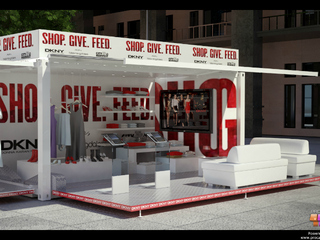
Mock-up of DKNY pop-up shop

Last year, DKNY offered a small sampling of its wares throughout Manhattan, housing them in a shipping container pop-up store. The need for a easy to set up (it took less than an hour!), portable design was critical to this project, as the store changed locations each day over the course of the three day event.

richard chai snarkitecture exterior
richardchaisnarkitectureinterior.jp

In 2010, fashion designer Richard Chai opened a pop-up store in Manhattan. Costing a mere $5,000, this location paired high fashion with flawless interior design.

The Starbucks Reclamation Drive-Thru

Starbucks Reclamation Drive Thru located in Tukwila, Washington has garnered a lot of attention since the 450 sq ft portable structure was constructed. Comprised of four salvaged shipping containers, it was designed specifically to explore new options in sustainability--showcasing the company's ongoing dedication to providing sustainable structures and business practices.

Ilan Dei pop-up shop in Venice

This shipping container houses the Ilan Dei Studio pop-up store and project lab, which opened in Venice, California earlier this month. The primary goal of this clean, modern design is to showcase the indoor-outdoor living of the California lifestyle. Three separate sections house a traditional lifestyle store, art gallery, and a community area for events such as yoga classes and ping pong games.

sustainable design, green design, shipping containers, shipping container architecture, Mexico, Container City, container restaurant, shipping container restaurant, recycled materials


shipping containers, shipping container architecture, Mexico, Container City, container restaurant, shipping container restaurant, recycled materials

One of my all time favorite use of salvaged shipping containers is Container City located in Cholula, Mexico. Restaurants, galleries, bars, stores and living spaces occupy the nearly 50 colorful containers carefully arranged to form courtyards, alleys, and streets.

The possibilities are endless when it comes to employing recycled shipping containers in design. From temporary pop-up stores to permanent cities, these structures provide a durable, eco-friendly alternative to conventional construction methods. This is one craze that has definitely caught my attention, and I anticipate it hanging around for many more years to come!

sources: one . two . three . four . five . six . seven

Monday, August 13, 2012

Building Information Modeling

In June, Advanced Cabinet Systems announced the release of their Revit Families Catalog. This was a significant step for the company in providing resources that meet the ever-changing demands of technology in the architectural community, while also allowing ACS products to be integrated into their drawings. In light of this release, I wanted to take a look at Building Information Modeling (BIM) and how it is helping to change the face of building construction.


The National Building Information Modeling Standard Project Committee (try saying that three times fast), defines BIM as "a digital representation of physical and functional characteristics of a facility. A BIM is a shared knowledge resource for information about a facility forming a reliable basis for decisions during its life-cycle; defined as existing from earliest conception to demolition." Now, after reading that definition I was still a little in the dark about what BIM actually was, so in case you are too, hopefully the rest of this post will clear it up a little better...


Building Information Modeling goes beyond the standard 2D drawings often used in construction, and renders the entire space in 3D--while also allowing the user to see the time and cost associated with each phase of the process. This allows for quick extraction of different views of the building, saving time and resources that would otherwise be spent on the drafting table, and allowing the project to proceed without delay. If problems are detected within the drawing, elements can be easily changed while also maintaining an updated schedule of materials for ordering and tracking purposes.


Another major benefit of BIM is the ease of which a job can be handed off from one person to the next. Gone are the days of having to keep track of page after page of changes and revisions, with BIM each worker adds to a single drawing file and hands it down to the next--lowering the potential that information will be lost in the process and reducing the chance that costly mistakes will be made as a result.


With tight schedules and budget constraints, Building Information Modeling helps architects, builders, and designers work quickly and efficiently by allowing them to visualize the space from start to finish. This allows them to work out any potential problems before construction even begins; saving valuable time and resources, and often leading to projects that finish ahead of schedule and under-budget.

sources: one . two . three . four

Monday, August 6, 2012

Book Stores in the Digital Age

A quick Google search on the “future of bookstores” brings up countless articles written over the past couple of years by bloggers, bookstore owners, news outlets, and vendors, each one with a unique opinion on how they think these establishments will look in the coming years. With the popularity of eReaders on the rise, as well as the closing of several of the largest bookstore chains in the country, there is no question that the face of bookstores is changing and retailers must either change with it or be prepared to close their doors in the coming years.
One trend that has been gaining attention in recent months is the Espresso Book Machine (EBM), which allows bookstores to access a large database of written works and print them in-house as needed.1 This allows owners to increase their inventory without the actual investment of having to stock physical copies in-store.4 Proponents of this machine argue that this not only eliminates the waste associated with overprinting, but lowers the cost of each book for the end user by reducing expenses associated with shipping and storing large inventories.1 Prices are also lowered as bookstores are able to essentially cut out the middle-man, i.e. printers and distributors, and sell directly to the customer. In a college bookstore setting, EBM would give educators the freedom to quickly change and update course material, giving students access to the most current information in their field while saving them the expense of having to purchase multiple editions of the same textbook.3


While the above facts would be enough to get many people on board with the Espresso Book Machine’s capabilities, there are a few things that potential buyers need to keep in mind before taking the plunge. The start-up cost associated with purchasing a single machine is significant, with some sources placing it in the $100k range.2 Pair this initial investment with the high cost of operating and staffing the machine and there-in lies the potential that EBM owners will not turn a profit for upwards of four years. Opponents of the EBM also reference the ability of express print shops, such as Fed Ex Office and Staples, to print and bind individual copies of books on machines that are currently found in their stores. Although these print-and-go locations currently do not have access to the extensive database provided by EBM, South African based Paperight is working to change that by connecting customers who want to purchase books with publishers who are interested in selling their products via local print shops.

Another book buying method that analysts believe will continue to gain speed is the eReader. With several versions already on the market today, Amazon is leading the way with their Kindle and Kindle Fire, with Barnes and Noble’s Nook quickly gaining ground. While many believe that eReaders will be the demise of the printed book industry, a few visionary booksellers are embracing these devices and their potential to increase sales with open arms. Google eBooks is partnering with independent bookstores across the nation, allowing customers to purchase e-books via a link on the store’s website with retailers receiving a 20-40% kickback on the profits.6  


With digital editions of textbooks now being introduced on a regular basis, campus bookstores would also be wise to jump on board with the eReader movement, renting devices to students that come preloaded with all of the course material for their current semester. Bookstore staff would then handle the transfer of information as a student progresses from class to class.3 This business model has been met with success at a library in Eau Claire, Wisconsin that lends out iPads to its cardholders, and there are an additional 11,000 libraries in the United States that allow patrons to borrow Kindle ebooks.5

If booksellers are not yet ready to dive into the world of digital books, there are numerous other measures that can be implemented into their day to day workings that are both low cost and high yield strategies to increase customer interaction. A functional website and Facebook account are easy ways to get your store’s name out there. An effective website will afford customers the opportunity to browse your inventory and allow them to purchase books for pick up in-store. Due to the often vast offerings of today’s bookstores, it is also a good idea to provide on-location access to your website and inventory to those patrons who may find such a large selection of books to be overwhelming.8 Incentive programs that give discounts to repeat customers can also be a low cost method of drumming up extra sales.4


In many communities, bookstores are seen as community centers where people gather to discuss, create, and listen. Organizing simple events such as monthly movie nights, game nights, and lectures from prominent members of the community will offer ways to stay connected with patrons.5 Other events might include book signings with well-known authors, poetry readings, art exhibits, or an open mic night.8 Keeping the surrounding community involved and engaged with your bookstore is paramount in making sure it does not go the way of record shops and video rental stores of the past.

The ability to celebrate holidays is one advantage that brick and mortar stores will always have over internet-based businesses. Shoppers are often sentimental when it comes to the changing of seasons and something as simple as putting out a bouquet of freshly sharpened pencils (a la You’ve Got Mail) for Back to School days or stringing a few twinkly lights (again, thank you Kathleen Kelly) for the holidays can make a huge difference in the mood of both your store employees and shoppers. Make your stores a haven for people to visit when they want to escape the fast pace of society.


As the need for physical books decreases in the coming years, bookstores will become smaller and more efficient9, allowing shop owners to allocate more money toward making sure their interior design and promotional displays are top notch. Many independent bookstores today often do not meet their full operating potential by ignoring the fact that their store fronts are a place for them to paint a picture of the magic that can be found just inside their doors.8 A few pillars displaying the latest books in print simply will not cut it—draw the casual passerby in with a fascinating window display and keep them coming back with a beautifully designed, well thought out space. Customers will appreciate comfortable areas throughout the store where they can gather in groups or get lost in a book by themselves. No one ever complained about free Wi-Fi or a coffee bar either!6

While it appears that companies such as Amazon, with their low prices and fast service, may indeed do away with the need for physical bookstores, there are still countless people who argue that the human need for the community that such a place offers will eventually prevail. People have the built in desire to interact with others and bookstores are a place where they can meet, learn, and discuss new ideas.7 Many book lovers will also agree that the experience of pulling a new book off the shelf and holding a physical copy in your hands cannot be matched by the low prices of Amazon or the instant satisfaction of downloading a book to your eReader at home. Bookstores help to enrich to lives of people that live in the communities where they are located and as the “buy local” movement sweeps across the nation, brick and mortar stores will be where people gravitate.6 In turn, owners need to make sure they are doing everything in their power to make their stores the best that they can be.


The importance of integrating technology, organizing community events, or decorating your store windows and interior cannot be stressed enough, but all of the effort that a store owner puts towards these things will be in vain if they have an inexperienced and incapable staff manning the sales floor. For many people, the reason they shop at bookstores instead of online is for the expertise of the owner and staff.3 It is vital to staff your stores with people who are passionate about books and are capable of making suggestions to customers about what they should read. In this day in age where online, shoppers are inundated with rating and reviews written by people they will never meet, it is a breath of fresh air to get an honest opinion from someone they can actually see. Owners must realize the important role that customer service plays in the survival of the brick and mortar bookstore.6 

While no one really knows for sure the direction that physical bookstores are headed until a major shift takes place, many people are making their predictions on the future that booksellers can expect to encounter in the coming years. One of them is David Houle, a strategist and keynote speaker who is consistently ranked as one of the top futurists. Houle believes that by the year 2015, the majority of books will be read via eReaders, adding, that as technology continues to get less expensive, the profit margin for these devices will disappear. By 2020, he believes that brick and mortar stores selling new books will be obsolete as new works are consumed almost entirely through digital readers. Houle also predicts that the bookstores capable of surviving the digital era will primarily sell used books as people will desire to have physical copies of those works that are sentimental to them.9


As bookstore owners are faced with the undeniable potential that their shops could suffer the same fate as the once thriving video rental business, they can take heart in the fact that there are still numerous strategies that can be implemented to keep their stores viable and relevant in the changing times. Engaging customers through community-based events, creating marketing strategies to reach a broader audience, embracing the ever-changing world of technology, and providing valuable customer service are just a few steps that can be taken toward ensuring that bookstores remain an essential component of the retail landscape.
What will the bookstore of the future look like? With owners that are forward thinking and willing to adapt, the possibilities are endless. 
sources: 1 . 2 . 3 . 4 . 5 . 6 . 7 . 8 . 9
pictures: one . two . three . four . five . six

Tuesday, July 31, 2012

Wood v. Chemical Resistant Plastic Laminates

For years, wooden cabinets have been the go-to solution for the storage of equipment and chemicals in science laboratories across the nation. From middle school labs to the more advanced labs found in higher education buildings, the general consensus among fixture specifiers seemed to be that wood was the best solution for these areas. In recent years, however, companies like Wilsonart and Formica have worked to change the minds of these individuals with the introduction of chemical resistant plastic laminates.


Although wood has the ability to withstand the physical wear and tear that a typical lab is routinely subjected to, it naturally omits acids and other pollutants, with oak (most often used) being the worst offender. The porous nature of wood allows it to easily absorb odor and contamination, as well as potentially harbor mold and other bacteria, all of which can be detrimental to sensitive test results. The density and hardness of plastic laminate means that it omits very little chemical gasses, and as long as it is glued to an NAUF substrate, offgasing of this material should also be of little concern.


Wilsonart’s Chemsurf and Formica’s ChemTop2 lines are an affordable alternative to wood cabinetry, wainscoting, and in some settings, are even suitable for use as counter tops. Each line carries a large variety of colors and patterns, making them great choices for lab areas that need to make a big statement. If the customer desires the look of wood with the functionality of laminate, they also come in a wide range of realistic wood grains. Each product's ability to resist harsh chemicals, stains, and mild abrasion make them a durable, long-lasting option for intermediate-type labs in hospitals, schools, and factories.


Over time, as wood surfaces are exposed to strong chemicals, excessive cleaning, and in some instances heat, they tend to lose their protective finish--leaving them susceptible to corrosion and staining. However, in rigorous product testing, both Wilsonart and Formica's chemical resistant laminates held up beautifully, with only a slight change in color or gloss when exposed to bright light and certain chemicals over prolonged periods of time.


While wooden casework needs routine cleaning and polishing to maintain its durability, with chemical resistant plastic laminate you simply wipe the surface clean--no scrubbing or harsh cleaning agents are required--offering years of superior performance that is unmatched by its competitor.

sources: one . two . three . four

Thursday, July 26, 2012

The Classroom

 By: Anna, ACS Intern

The learning environment is defined by several factors that must be considered when designing a classroom space. Throughout my research for this project I have narrowed these down to the five most important things to consider when designing an educational setting.


Layout/Furniture
In the past, classrooms have been restricted to fairly simple layouts. Options for arranging standard desks and tables, while still maintaining functionality, are limited--often resulting in spaces that are monotonous and expected. Companies such as Herman Miller, Steelcase, and Hon have done extensive research and developed innovative furniture systems specifically for educational use. These systems can be used in a variety of ways to create spaces for group learning, collaboration, and lecture. 


Color
Color is an important factor in the physical learning environment that has an impact on student achievement, as well as teachers' effectiveness and staff efficiency. Specific colors and patterns have a direct influence on the health, morale, emotions, behavior, and performance of learners. Color increases students' capability to think, create, and invent, while also enhancing their ability to express themselves, work together, and organize. When selecting a color for a learning environment it is important to research and consider the effects it will have on students and educators. 


Illumination
Illumination within the classroom is often achieved through the easy and economical solution of fluorescent lights on a dimmer. However, designers are now rethinking the effectiveness of this solution as current studies are showing the degree to which lighting affects a student's classroom performance. Illumination encompasses aspects much broader than the standard overhead electric lighting system--illumination also refers to direct natural light, indirect natural light, indirect artificial light, reflected light, and the control of all sources. Poor lighting controls have a negative impact on occupants; glare, eye strain, fatigue, decreased attention span, increased body temperature and poor student/teacher performance. The proper use of illumination can have very positive outcomes resulting in improved test scores, reduction of poor behavior, and higher student achievement. Natural daylight should be the primary source of lighting in schools, supplemented by electric light when daylight fades.


Distractions
Within seconds, a student's attention can quickly move from the teacher or activity at hand to being distracted by what is outside of the window, over hearing a class next door, or watching a pupil within their own classroom. There are numerous distractions within a learning environment and the physical layout of the space can greatly affect active learning, while helping to minimize well-known attention-stealers. The ability for a student to hear and understand what is being said in the classroom is necessary for effective learning and high academic performance. An environment with poor acoustics builds a communication barrier which often leads to distant and distracted students. A few easy ways for designers and educators to reduce classroom distractions would be to use noise reduction panels to absorb excess sound, be conscience of door and window placement, and make sure that the physical layout of the space lends itself to keeping students focused on the task at hand.


Air Quality
Providing clean air is beneficial to students and educators. Due to the small amount of square footage available per child in an educational environment, it is no shock that schools have a major concern for indoor air quality. A lack of clean air can result in an increase in allergies and asthma, with these ailments accounting for nearly 12.8 million days of school missed by students in the U.S. Ironically, the students themselves are the main source of contamination; bacteria is created by the acts of body respiration and increased metabolism. Other items contributing to poor air quality include books, writing materials, clothing, and at times computer equipment. 

There are three major things to consider when evaluating the air quality within the classroom, the first being source control. Any source of air pollution, such as standing buses, glues, paints, and markers must be removed or stored separately from the classroom. Secondly, the ventilation must be checked. Ventilation is needed because it prevents stale air from building up as a result of increased levels of carbon dioxide and VOC's. The HVAC system must then properly circulate the fresh air at a comfortable temperature and humidity level. The final thing to consider is filtration. Filters are highly recommended as the best technology to remove airborne particles, and it is vital to take precautionary measures to ensure that clean air is being provided to the students and educators.


These five factors help to create a successful learning environment. Focusing on at least one of these categories could entirely change a classrooms aesthetic, but when all five are considered during the design process, what results is the ability to change the face of the classroom setting.

sources: one . two . three . four . five

Wednesday, July 18, 2012

Flexible Learning Environments

As a follow up to last week's blog, "Environmental Effects on Learning", I've compile a few examples of well designed classrooms from across the web. These spaces show a creative use of color, materials, and furnishings while maintaining a high level of flexibility that allows them to be used for a wide range of activities.

As a student, I know I would have loved learning in these environments!

Desks and chairs on casters keep this space flexible and allow for quick and easy reconfiguring.

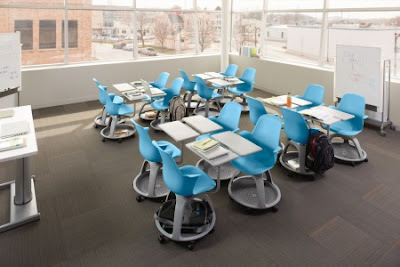
Brightly colored and ultra-portable, these desks can turn any space into a fun learning area.

Moveable glass walls and multipurpose furniture make this space perfect for both teacher led discussions and group collaboration.

A desk/chair combo on wheels allows for an unlimited number of seating configurations.

Brightly colored furniture makes this classroom a fun and inviting learning environment.

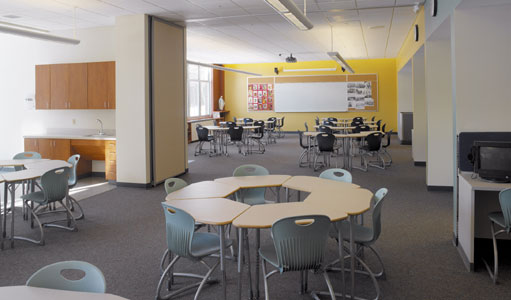
A large room with moveable furniture allows for multiple learning activities to take place simultaneously.

In many climates, a covered outdoor area can be utilized by students nearly year round, giving them access to fresh air and sunshine.

A large room with walls that tuck neatly away provides just the right amount of classroom space, while still allowing the space to be utilized by larger groups.

Moveable window-walls help bring in the outdoors in this learning environment.

A compact stage/bleacher area saves spaces and makes this corridor functional.

sources: one . two . three . four . five . six . seven . eight . nine . ten

Wednesday, July 11, 2012

Environmental Effects on Learning

By: Anna, ACS Intern

Over the last two months I have had the opportunity to team up with Advanced Cabinet Systems to conduct a study examining the effects that environment has on learning. Throughout my time spent researching and designing the ideal classroom setting, my eyes have been opened to the inefficient practices used within the majority of classrooms in today's school systems, as well as the great need for designers to create learning environments that will have a positive, lasting effect on the next generation. The following is an excerpt of my research that will be released in its entirety later this month. 
No two individuals think exactly alike, therefore, there is no easy way to know what is best for every person in a specific scenario. What if the environment of a classroom could be manipulated by architects and designers to create a space that is more conducive to learning? The face of education has changed immensely over the past century--so why hasn’t the classroom? 
Numerous studies have shown that classrooms found in today's schools are typically designed to meet the needs of the educator, while often disregarding the needs of the student. A classroom set up around the needs of the educator is usually only beneficial to one person--the educator. This can present a serious stumbling block for a student's success in school. When the only choice is to listen, watch, and learn in a space that is rarely comfortable and highly constrictive, educators are left with lasting results that are less than impressive. As a future designer, this leaves me to question why the current design of classrooms largely favors the educator, when education at large was established to target the children? 
By understanding the different styles of learning from one student to the next, we can better understand how to effectively tailor our designs to reach the needs of all people in an educational environment. When each style of learning is uniquely analyzed and incorporated into the classroom design, a space can be created to meet the needs of all students and assist them in furthering their education. The idea of teachers researching each child and tailoring their teaching methods to fit their specific style of learning is a relatively new approach to education. Traditionally, schools have used linguistic and logical teaching methods to assess students, but this approach is becoming outdated and irrelevant to the modern learner. Much like the traditional approach to teaching is being reassessed, so should the spaces where education is taking place.
The intergration of technology in the classroom is quickly changing education and learning environments. Most students in school today have a cell phone, an iPod, and commonly their own personal laptop. Though these items are great tools for research, communication, and innovation, students are often found using them within their learning environment as tools of distraction, leaving educators to wonder if they truly deserve a regular place within the classroom. When used correctly technology has the ability to decrease student distraction and increase engagement. Educators have a variety of options for creatively intergrating technology into their lesson plans, from using cell phones as clickers for answer questions, to using laptops for immediate research and collaboration. If done correctly technology can be an effective tool that engages students in their work.
If designers and educators come together to make these changes the classrooms of the future will have very little in common with those of today, allowing young minds to develop in an environment that is conducive to their learning style and encouraging them to be more than they could ever imagine. 
Be sure to check back during the week of July 23rd for another excerpt from my research on how designers can combat the decline of the classroom and create spaces that are tailored to give all students an equal opportunity at finding educational success.

sources: one . two . three . four

Friday, July 6, 2012

Selecting Flooring and Paint

Flooring and paint selection are two elements of retail design that when chosen correctly can save you a lot of headache down the road. It is important to specify finishes that are commercial grade and will hold up well in a retail setting. While the initial investment for commercial materials may be higher, the cost will eventually even out--and in some cases even be lower--in comparison to purchasing non-commercial grade products, as they will often need replaced sooner. This is a key component in making sure the money you spend upfront implementing your design is not wasted on fixtures and finishes that are not meant to withstand retail traffic. The materials you choose should not only look and function well, but have minimal maintenance requirements.

Flooring

There are several things to consider when choosing flooring for your store...
  1. What kind of mood are you trying to set? Commercial flooring companies now offer their products in a wide range of colors and materials. Gone are the days of traditional floors in neutral colors, as designers are making flooring an important part of the design concept with bold colors and patterns.

    Colorful Floors
  2. How much foot traffic will the flooring get? Durability is vital in choosing a commercial grade floor covering as the product will often need to withstand a large number of customers each day. If possible, choose a flooring that is easy to clean and hides dirt and scuffs well. Consider investing in carpet tiles--as individual squares can quickly be replaced should the need arise--but make sure to purchase enough replacements from your original dye-lot as colors can often vary from one lot to the next.

    wood_big
  3. How much standing will my employees and customers do? If the answer is a lot, it is important to choose a material that will help to reduce fatigue and potential leg and back pain. As a general rule, the less amount of give that a surface has, the harder it will be on your joints. Choosing a softer flooring with a little bit of give to it will greatly benefit employees that need to stand all day. If you are dead set on having, say, exposed concrete floors, do your employees and customers a favor by adding anti-fatigue mats in areas that they will be standing at most throughout the day. Trust me, they will thank you!


  4. Is noise an issue? If so, stick with softer finishes that will absorb the sound of footsteps or invest in a good underlay that will help quiet walking noise on laminate or hardwood floors.

    Interior decorating carpets decor
Paint


Paint comes in a wide variety of finishes that can either work for you or against you. Choosing the correct finish for your walls and fixtures will ensure that they are easy to clean and will not need repeated touch ups or repaints that are both time consuming and costly.
  1. Matte/Flat: This is the least glossy finish which makes it a great choice for covering existing wall colors or hiding imperfections. It is very susceptible to stains and scuff marks and does not hold up well against scrubbing, therefore it is best applied to ceilings and low traffic areas. 
  2. Eggshell and Satin: These finishes have a hint of glossiness compared to flat, with satin being the glossier of the two. They are durable and easy to clean making them a good choice for walls in nearly every type of setting. 
  3. Semi-Gloss: Even glossier than eggshell and satin, this finish offers great durability in high-traffic areas that will receive heavy cleaning regularly. Semi-gloss is a great choice for cabinets and trim, as well as high moisture areas such as restrooms and kitchens. 
  4. Gloss: Drying to create an almost laminate-like surface that is extremely durable, this finish is not typically used in interiors. 
sources: one . two . three . four . five