Showing posts with label flexible classrooms. Show all posts

Thursday, July 26, 2012

The Classroom

 By: Anna, ACS Intern

The learning environment is defined by several factors that must be considered when designing a classroom space. Throughout my research for this project I have narrowed these down to the five most important things to consider when designing an educational setting.


Layout/Furniture
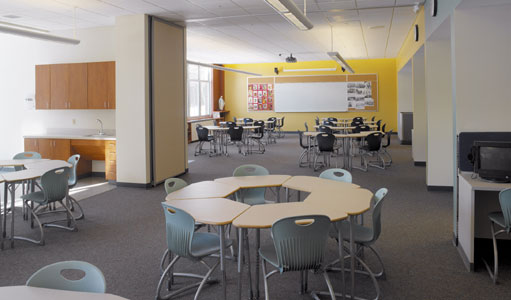
In the past, classrooms have been restricted to fairly simple layouts. Options for arranging standard desks and tables, while still maintaining functionality, are limited--often resulting in spaces that are monotonous and expected. Companies such as Herman Miller, Steelcase, and Hon have done extensive research and developed innovative furniture systems specifically for educational use. These systems can be used in a variety of ways to create spaces for group learning, collaboration, and lecture. 

Color
Color is an important factor in the physical learning environment that has an impact on student achievement, as well as teachers' effectiveness and staff efficiency. Specific colors and patterns have a direct influence on the health, morale, emotions, behavior, and performance of learners. Color increases students' capability to think, create, and invent, while also enhancing their ability to express themselves, work together, and organize. When selecting a color for a learning environment it is important to research and consider the effects it will have on students and educators. 


Illumination
Illumination within the classroom is often achieved through the easy and economical solution of fluorescent lights on a dimmer. However, designers are now rethinking the effectiveness of this solution as current studies are showing the degree to which lighting affects a student's classroom performance. Illumination encompasses aspects much broader than the standard overhead electric lighting system--illumination also refers to direct natural light, indirect natural light, indirect artificial light, reflected light, and the control of all sources. Poor lighting controls have a negative impact on occupants; glare, eye strain, fatigue, decreased attention span, increased body temperature and poor student/teacher performance. The proper use of illumination can have very positive outcomes resulting in improved test scores, reduction of poor behavior, and higher student achievement. Natural daylight should be the primary source of lighting in schools, supplemented by electric light when daylight fades.


Distractions
Within seconds, a student's attention can quickly move from the teacher or activity at hand to being distracted by what is outside of the window, over hearing a class next door, or watching a pupil within their own classroom. There are numerous distractions within a learning environment and the physical layout of the space can greatly affect active learning, while helping to minimize well-known attention-stealers. The ability for a student to hear and understand what is being said in the classroom is necessary for effective learning and high academic performance. An environment with poor acoustics builds a communication barrier which often leads to distant and distracted students. A few easy ways for designers and educators to reduce classroom distractions would be to use noise reduction panels to absorb excess sound, be conscience of door and window placement, and make sure that the physical layout of the space lends itself to keeping students focused on the task at hand.


Air Quality
Providing clean air is beneficial to students and educators. Due to the small amount of square footage available per child in an educational environment, it is no shock that schools have a major concern for indoor air quality. A lack of clean air can result in an increase in allergies and asthma, with these ailments accounting for nearly 12.8 million days of school missed by students in the U.S. Ironically, the students themselves are the main source of contamination; bacteria is created by the acts of body respiration and increased metabolism. Other items contributing to poor air quality include books, writing materials, clothing, and at times computer equipment. 

There are three major things to consider when evaluating the air quality within the classroom, the first being source control. Any source of air pollution, such as standing buses, glues, paints, and markers must be removed or stored separately from the classroom. Secondly, the ventilation must be checked. Ventilation is needed because it prevents stale air from building up as a result of increased levels of carbon dioxide and VOC's. The HVAC system must then properly circulate the fresh air at a comfortable temperature and humidity level. The final thing to consider is filtration. Filters are highly recommended as the best technology to remove airborne particles, and it is vital to take precautionary measures to ensure that clean air is being provided to the students and educators.


These five factors help to create a successful learning environment. Focusing on at least one of these categories could entirely change a classrooms aesthetic, but when all five are considered during the design process, what results is the ability to change the face of the classroom setting.

sources: one . two . three . four . five

Wednesday, July 18, 2012

Flexible Learning Environments

As a follow up to last week's blog, "Environmental Effects on Learning", I've compile a few examples of well designed classrooms from across the web. These spaces show a creative use of color, materials, and furnishings while maintaining a high level of flexibility that allows them to be used for a wide range of activities.

As a student, I know I would have loved learning in these environments!

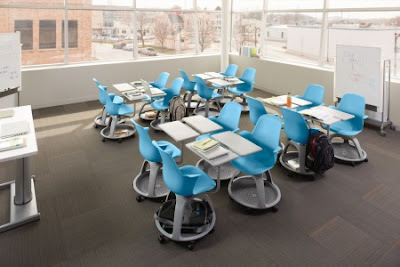
Desks and chairs on casters keep this space flexible and allow for quick and easy reconfiguring.

Brightly colored and ultra-portable, these desks can turn any space into a fun learning area.

Moveable glass walls and multipurpose furniture make this space perfect for both teacher led discussions and group collaboration.

A desk/chair combo on wheels allows for an unlimited number of seating configurations.

Brightly colored furniture makes this classroom a fun and inviting learning environment.

A large room with moveable furniture allows for multiple learning activities to take place simultaneously.

In many climates, a covered outdoor area can be utilized by students nearly year round, giving them access to fresh air and sunshine.

A large room with walls that tuck neatly away provides just the right amount of classroom space, while still allowing the space to be utilized by larger groups.

Moveable window-walls help bring in the outdoors in this learning environment.

A compact stage/bleacher area saves spaces and makes this corridor functional.

sources: one . two . three . four . five . six . seven . eight . nine . ten

Wednesday, July 11, 2012

Environmental Effects on Learning

By: Anna, ACS Intern

Over the last two months I have had the opportunity to team up with Advanced Cabinet Systems to conduct a study examining the effects that environment has on learning. Throughout my time spent researching and designing the ideal classroom setting, my eyes have been opened to the inefficient practices used within the majority of classrooms in today's school systems, as well as the great need for designers to create learning environments that will have a positive, lasting effect on the next generation. The following is an excerpt of my research that will be released in its entirety later this month. 
No two individuals think exactly alike, therefore, there is no easy way to know what is best for every person in a specific scenario. What if the environment of a classroom could be manipulated by architects and designers to create a space that is more conducive to learning? The face of education has changed immensely over the past century--so why hasn’t the classroom? 
Numerous studies have shown that classrooms found in today's schools are typically designed to meet the needs of the educator, while often disregarding the needs of the student. A classroom set up around the needs of the educator is usually only beneficial to one person--the educator. This can present a serious stumbling block for a student's success in school. When the only choice is to listen, watch, and learn in a space that is rarely comfortable and highly constrictive, educators are left with lasting results that are less than impressive. As a future designer, this leaves me to question why the current design of classrooms largely favors the educator, when education at large was established to target the children? 
By understanding the different styles of learning from one student to the next, we can better understand how to effectively tailor our designs to reach the needs of all people in an educational environment. When each style of learning is uniquely analyzed and incorporated into the classroom design, a space can be created to meet the needs of all students and assist them in furthering their education. The idea of teachers researching each child and tailoring their teaching methods to fit their specific style of learning is a relatively new approach to education. Traditionally, schools have used linguistic and logical teaching methods to assess students, but this approach is becoming outdated and irrelevant to the modern learner. Much like the traditional approach to teaching is being reassessed, so should the spaces where education is taking place.
The intergration of technology in the classroom is quickly changing education and learning environments. Most students in school today have a cell phone, an iPod, and commonly their own personal laptop. Though these items are great tools for research, communication, and innovation, students are often found using them within their learning environment as tools of distraction, leaving educators to wonder if they truly deserve a regular place within the classroom. When used correctly technology has the ability to decrease student distraction and increase engagement. Educators have a variety of options for creatively intergrating technology into their lesson plans, from using cell phones as clickers for answer questions, to using laptops for immediate research and collaboration. If done correctly technology can be an effective tool that engages students in their work.
If designers and educators come together to make these changes the classrooms of the future will have very little in common with those of today, allowing young minds to develop in an environment that is conducive to their learning style and encouraging them to be more than they could ever imagine. 
Be sure to check back during the week of July 23rd for another excerpt from my research on how designers can combat the decline of the classroom and create spaces that are tailored to give all students an equal opportunity at finding educational success.

sources: one . two . three . four