Showing posts with label schools. Show all posts

Tuesday, July 31, 2012

Wood v. Chemical Resistant Plastic Laminates

For years, wooden cabinets have been the go-to solution for the storage of equipment and chemicals in science laboratories across the nation. From middle school labs to the more advanced labs found in higher education buildings, the general consensus among fixture specifiers seemed to be that wood was the best solution for these areas. In recent years, however, companies like Wilsonart and Formica have worked to change the minds of these individuals with the introduction of chemical resistant plastic laminates.


Although wood has the ability to withstand the physical wear and tear that a typical lab is routinely subjected to, it naturally omits acids and other pollutants, with oak (most often used) being the worst offender. The porous nature of wood allows it to easily absorb odor and contamination, as well as potentially harbor mold and other bacteria, all of which can be detrimental to sensitive test results. The density and hardness of plastic laminate means that it omits very little chemical gasses, and as long as it is glued to an NAUF substrate, offgasing of this material should also be of little concern.


Wilsonart’s Chemsurf and Formica’s ChemTop2 lines are an affordable alternative to wood cabinetry, wainscoting, and in some settings, are even suitable for use as counter tops. Each line carries a large variety of colors and patterns, making them great choices for lab areas that need to make a big statement. If the customer desires the look of wood with the functionality of laminate, they also come in a wide range of realistic wood grains. Each product's ability to resist harsh chemicals, stains, and mild abrasion make them a durable, long-lasting option for intermediate-type labs in hospitals, schools, and factories.


Over time, as wood surfaces are exposed to strong chemicals, excessive cleaning, and in some instances heat, they tend to lose their protective finish--leaving them susceptible to corrosion and staining. However, in rigorous product testing, both Wilsonart and Formica's chemical resistant laminates held up beautifully, with only a slight change in color or gloss when exposed to bright light and certain chemicals over prolonged periods of time.


While wooden casework needs routine cleaning and polishing to maintain its durability, with chemical resistant plastic laminate you simply wipe the surface clean--no scrubbing or harsh cleaning agents are required--offering years of superior performance that is unmatched by its competitor.

sources: one . two . three . four

Thursday, July 26, 2012

The Classroom

 By: Anna, ACS Intern

The learning environment is defined by several factors that must be considered when designing a classroom space. Throughout my research for this project I have narrowed these down to the five most important things to consider when designing an educational setting.


Layout/Furniture
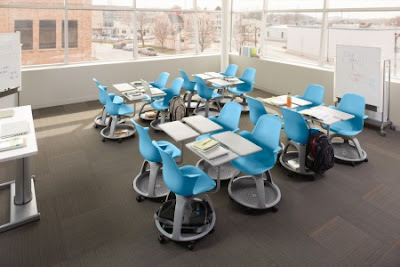
In the past, classrooms have been restricted to fairly simple layouts. Options for arranging standard desks and tables, while still maintaining functionality, are limited--often resulting in spaces that are monotonous and expected. Companies such as Herman Miller, Steelcase, and Hon have done extensive research and developed innovative furniture systems specifically for educational use. These systems can be used in a variety of ways to create spaces for group learning, collaboration, and lecture. 


Color
Color is an important factor in the physical learning environment that has an impact on student achievement, as well as teachers' effectiveness and staff efficiency. Specific colors and patterns have a direct influence on the health, morale, emotions, behavior, and performance of learners. Color increases students' capability to think, create, and invent, while also enhancing their ability to express themselves, work together, and organize. When selecting a color for a learning environment it is important to research and consider the effects it will have on students and educators. 


Illumination
Illumination within the classroom is often achieved through the easy and economical solution of fluorescent lights on a dimmer. However, designers are now rethinking the effectiveness of this solution as current studies are showing the degree to which lighting affects a student's classroom performance. Illumination encompasses aspects much broader than the standard overhead electric lighting system--illumination also refers to direct natural light, indirect natural light, indirect artificial light, reflected light, and the control of all sources. Poor lighting controls have a negative impact on occupants; glare, eye strain, fatigue, decreased attention span, increased body temperature and poor student/teacher performance. The proper use of illumination can have very positive outcomes resulting in improved test scores, reduction of poor behavior, and higher student achievement. Natural daylight should be the primary source of lighting in schools, supplemented by electric light when daylight fades.


Distractions
Within seconds, a student's attention can quickly move from the teacher or activity at hand to being distracted by what is outside of the window, over hearing a class next door, or watching a pupil within their own classroom. There are numerous distractions within a learning environment and the physical layout of the space can greatly affect active learning, while helping to minimize well-known attention-stealers. The ability for a student to hear and understand what is being said in the classroom is necessary for effective learning and high academic performance. An environment with poor acoustics builds a communication barrier which often leads to distant and distracted students. A few easy ways for designers and educators to reduce classroom distractions would be to use noise reduction panels to absorb excess sound, be conscience of door and window placement, and make sure that the physical layout of the space lends itself to keeping students focused on the task at hand.


Air Quality
Providing clean air is beneficial to students and educators. Due to the small amount of square footage available per child in an educational environment, it is no shock that schools have a major concern for indoor air quality. A lack of clean air can result in an increase in allergies and asthma, with these ailments accounting for nearly 12.8 million days of school missed by students in the U.S. Ironically, the students themselves are the main source of contamination; bacteria is created by the acts of body respiration and increased metabolism. Other items contributing to poor air quality include books, writing materials, clothing, and at times computer equipment. 

There are three major things to consider when evaluating the air quality within the classroom, the first being source control. Any source of air pollution, such as standing buses, glues, paints, and markers must be removed or stored separately from the classroom. Secondly, the ventilation must be checked. Ventilation is needed because it prevents stale air from building up as a result of increased levels of carbon dioxide and VOC's. The HVAC system must then properly circulate the fresh air at a comfortable temperature and humidity level. The final thing to consider is filtration. Filters are highly recommended as the best technology to remove airborne particles, and it is vital to take precautionary measures to ensure that clean air is being provided to the students and educators.


These five factors help to create a successful learning environment. Focusing on at least one of these categories could entirely change a classrooms aesthetic, but when all five are considered during the design process, what results is the ability to change the face of the classroom setting.

sources: one . two . three . four . five