Showing posts with label color. Show all posts

Thursday, July 26, 2012

The Classroom

 By: Anna, ACS Intern

The learning environment is defined by several factors that must be considered when designing a classroom space. Throughout my research for this project I have narrowed these down to the five most important things to consider when designing an educational setting.


Layout/Furniture
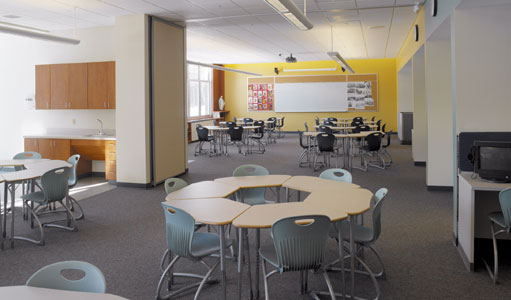
In the past, classrooms have been restricted to fairly simple layouts. Options for arranging standard desks and tables, while still maintaining functionality, are limited--often resulting in spaces that are monotonous and expected. Companies such as Herman Miller, Steelcase, and Hon have done extensive research and developed innovative furniture systems specifically for educational use. These systems can be used in a variety of ways to create spaces for group learning, collaboration, and lecture. 

Color
Color is an important factor in the physical learning environment that has an impact on student achievement, as well as teachers' effectiveness and staff efficiency. Specific colors and patterns have a direct influence on the health, morale, emotions, behavior, and performance of learners. Color increases students' capability to think, create, and invent, while also enhancing their ability to express themselves, work together, and organize. When selecting a color for a learning environment it is important to research and consider the effects it will have on students and educators. 


Illumination
Illumination within the classroom is often achieved through the easy and economical solution of fluorescent lights on a dimmer. However, designers are now rethinking the effectiveness of this solution as current studies are showing the degree to which lighting affects a student's classroom performance. Illumination encompasses aspects much broader than the standard overhead electric lighting system--illumination also refers to direct natural light, indirect natural light, indirect artificial light, reflected light, and the control of all sources. Poor lighting controls have a negative impact on occupants; glare, eye strain, fatigue, decreased attention span, increased body temperature and poor student/teacher performance. The proper use of illumination can have very positive outcomes resulting in improved test scores, reduction of poor behavior, and higher student achievement. Natural daylight should be the primary source of lighting in schools, supplemented by electric light when daylight fades.


Distractions
Within seconds, a student's attention can quickly move from the teacher or activity at hand to being distracted by what is outside of the window, over hearing a class next door, or watching a pupil within their own classroom. There are numerous distractions within a learning environment and the physical layout of the space can greatly affect active learning, while helping to minimize well-known attention-stealers. The ability for a student to hear and understand what is being said in the classroom is necessary for effective learning and high academic performance. An environment with poor acoustics builds a communication barrier which often leads to distant and distracted students. A few easy ways for designers and educators to reduce classroom distractions would be to use noise reduction panels to absorb excess sound, be conscience of door and window placement, and make sure that the physical layout of the space lends itself to keeping students focused on the task at hand.


Air Quality
Providing clean air is beneficial to students and educators. Due to the small amount of square footage available per child in an educational environment, it is no shock that schools have a major concern for indoor air quality. A lack of clean air can result in an increase in allergies and asthma, with these ailments accounting for nearly 12.8 million days of school missed by students in the U.S. Ironically, the students themselves are the main source of contamination; bacteria is created by the acts of body respiration and increased metabolism. Other items contributing to poor air quality include books, writing materials, clothing, and at times computer equipment. 

There are three major things to consider when evaluating the air quality within the classroom, the first being source control. Any source of air pollution, such as standing buses, glues, paints, and markers must be removed or stored separately from the classroom. Secondly, the ventilation must be checked. Ventilation is needed because it prevents stale air from building up as a result of increased levels of carbon dioxide and VOC's. The HVAC system must then properly circulate the fresh air at a comfortable temperature and humidity level. The final thing to consider is filtration. Filters are highly recommended as the best technology to remove airborne particles, and it is vital to take precautionary measures to ensure that clean air is being provided to the students and educators.


These five factors help to create a successful learning environment. Focusing on at least one of these categories could entirely change a classrooms aesthetic, but when all five are considered during the design process, what results is the ability to change the face of the classroom setting.

sources: one . two . three . four . five

Wednesday, July 18, 2012

Flexible Learning Environments

As a follow up to last week's blog, "Environmental Effects on Learning", I've compile a few examples of well designed classrooms from across the web. These spaces show a creative use of color, materials, and furnishings while maintaining a high level of flexibility that allows them to be used for a wide range of activities.

As a student, I know I would have loved learning in these environments!

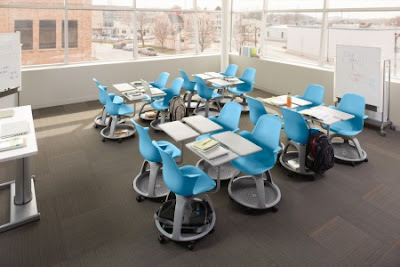
Desks and chairs on casters keep this space flexible and allow for quick and easy reconfiguring.

Brightly colored and ultra-portable, these desks can turn any space into a fun learning area.

Moveable glass walls and multipurpose furniture make this space perfect for both teacher led discussions and group collaboration.

A desk/chair combo on wheels allows for an unlimited number of seating configurations.

Brightly colored furniture makes this classroom a fun and inviting learning environment.

A large room with moveable furniture allows for multiple learning activities to take place simultaneously.

In many climates, a covered outdoor area can be utilized by students nearly year round, giving them access to fresh air and sunshine.

A large room with walls that tuck neatly away provides just the right amount of classroom space, while still allowing the space to be utilized by larger groups.

Moveable window-walls help bring in the outdoors in this learning environment.

A compact stage/bleacher area saves spaces and makes this corridor functional.

sources: one . two . three . four . five . six . seven . eight . nine . ten

Friday, July 6, 2012

Selecting Flooring and Paint

Flooring and paint selection are two elements of retail design that when chosen correctly can save you a lot of headache down the road. It is important to specify finishes that are commercial grade and will hold up well in a retail setting. While the initial investment for commercial materials may be higher, the cost will eventually even out--and in some cases even be lower--in comparison to purchasing non-commercial grade products, as they will often need replaced sooner. This is a key component in making sure the money you spend upfront implementing your design is not wasted on fixtures and finishes that are not meant to withstand retail traffic. The materials you choose should not only look and function well, but have minimal maintenance requirements.

Flooring

There are several things to consider when choosing flooring for your store...
  1. What kind of mood are you trying to set? Commercial flooring companies now offer their products in a wide range of colors and materials. Gone are the days of traditional floors in neutral colors, as designers are making flooring an important part of the design concept with bold colors and patterns.

    Colorful Floors
  2. How much foot traffic will the flooring get? Durability is vital in choosing a commercial grade floor covering as the product will often need to withstand a large number of customers each day. If possible, choose a flooring that is easy to clean and hides dirt and scuffs well. Consider investing in carpet tiles--as individual squares can quickly be replaced should the need arise--but make sure to purchase enough replacements from your original dye-lot as colors can often vary from one lot to the next.

    wood_big
  3. How much standing will my employees and customers do? If the answer is a lot, it is important to choose a material that will help to reduce fatigue and potential leg and back pain. As a general rule, the less amount of give that a surface has, the harder it will be on your joints. Choosing a softer flooring with a little bit of give to it will greatly benefit employees that need to stand all day. If you are dead set on having, say, exposed concrete floors, do your employees and customers a favor by adding anti-fatigue mats in areas that they will be standing at most throughout the day. Trust me, they will thank you!


  4. Is noise an issue? If so, stick with softer finishes that will absorb the sound of footsteps or invest in a good underlay that will help quiet walking noise on laminate or hardwood floors.

    Interior decorating carpets decor
Paint


Paint comes in a wide variety of finishes that can either work for you or against you. Choosing the correct finish for your walls and fixtures will ensure that they are easy to clean and will not need repeated touch ups or repaints that are both time consuming and costly.
  1. Matte/Flat: This is the least glossy finish which makes it a great choice for covering existing wall colors or hiding imperfections. It is very susceptible to stains and scuff marks and does not hold up well against scrubbing, therefore it is best applied to ceilings and low traffic areas. 
  2. Eggshell and Satin: These finishes have a hint of glossiness compared to flat, with satin being the glossier of the two. They are durable and easy to clean making them a good choice for walls in nearly every type of setting. 
  3. Semi-Gloss: Even glossier than eggshell and satin, this finish offers great durability in high-traffic areas that will receive heavy cleaning regularly. Semi-gloss is a great choice for cabinets and trim, as well as high moisture areas such as restrooms and kitchens. 
  4. Gloss: Drying to create an almost laminate-like surface that is extremely durable, this finish is not typically used in interiors. 
sources: one . two . three . four . five

Monday, June 11, 2012

The Effects of Color on Design

Throughout the design process of our most recent line of retail fixtures, I was approached numerous times with questions pertaining to color; what color should the pieces be, the flooring, the walls? Choosing the wrong color for any of these elements held the potential to throw off the atmosphere we were working so hard to create.

Since color has the incredible ability of evoking an emotional response in most people, it plays a huge role in either making or breaking a design. A well thought through color palette can do wonders for mediocre design, while a poor choice of colors can put a damper on even the greatest of designs.

Let’s take a look at the feelings colors are able to stir within us, as well as a few great applications of color throughout the design world...
Red: 
  • Excitement, passion, attention, love
  • Red can make a small room feel even smaller--try incorporating it on one or two accent walls.
  • Pairing red with bold prints and patterns can help tone down the saturation of the color.
  • Studies have shown that predominately red rooms may lead to a temporary increase in blood pressure.
Orange:
  • Playful, energetic, cheerful
  • Orange has all of the personality of red without being as aggressive.
  • It pairs nicely with white, modern furnishings and bold prints. 
  • Orange is a hunger-inducing color.
  • When it is closer to peach in hue, orange has the ability to enhance some complexions, making it a great choice for a restroom or changing room. 

Yellow:
  • Sunny, tropical, safety
  • Yellow is a great choice for poorly lit spaces as it helps to brighten the area more effectively than white. 
  • Pair yellow with white accents for a cheerful, relaxed atmosphere. 
  • Yellow walls combined with black accents will create an unexpected modern twist in an otherwise elegant setting.

Purple:
  • Royalty, wealth, intrigue, creativity
  • Purple combines the stability of blue with the energy of red.
  • It is believed that purple helps to develop imagination in children, making it a great choice for playrooms and classroom settings.
  • Like the majority of highly saturated colors, purple pairs nicely with an otherwise neutral palette.

Green:
  • Relax, inspire, nature, renewal
  • The relaxing qualities of green make it an excellent background color for meditation and tasks that require a high level of concentration.
  • Deep shades of green will produce a more opulent atmosphere, while lighter shades tend to create a fresh, lively setting.

Blue:
  • Relax, refresh, inspire
  • While blue holds many of the same relaxing qualities of green, light blue can make large areas feel cold and bleak while may lead to distress in people confined to the space for long periods of time.
  • Mixing white accents within a blue room creates a light, airy atmosphere, making this combination perfect for sunrooms, reading rooms, and bedrooms.

White: 
  • Purity, cleaness, calm
  • White is the perfect neutral background for all other colors.
  • Under-stimulation with this color can lead to restlessness and difficulty concentrating, therefore, great care shoul be taken to balance a stark white room with enough color to add warmth and visual interest to the space.


Gray:
  • Neutrality, stability, respect
  • Similar to white, gray provides an excellent neutral palette for other colors and textures.
  • Dark, saturated hues of gray can be used to create an elegant atmosphere, while adding warmth and sophistication to the space.