Phil Bowers, VP of Business Development at ACS, was recently featured on the Woodworking Network's blog with a great article on embracing technology within the casework manufacturing industry.
Be sure to check it out here!

Friday, October 19, 2012

Saturday, October 13, 2012
Cabinet Core Materials
As a designer at a fixture company, I should have some understanding of what goes in to making a cabinet--you start with some type of middle material and put a laminate on it, right? Well, yes, but while I never knew the specifics, I had a feeling there is actually a little more to it. So when my boss approached me about putting together a list of cabinet core materials, I thought, "Simple! Two, three choices max?" Wrong! There are so many to chose from, and each option has its pros and cons. Pick the right one and you have a sturdy, well made cabinet that will stand the test of time. Pick the wrong one and you may be replacing your cabinets a little more often than you had anticipated!
While you might not get the opportunity to put this information to use on a regular basis, if you play any type of role in specifying, purchasing, or installing cabinetry it is helpful to have a basic understanding of how the product is constructed.
Read on for a run-down of core materials...
1. Plywood
- Strong
- Doesn't pose the cracking, warping or shrinking threat of solid wood
- Can be manufactured in very large sheets
- Two types:
- Hardwood Plywood
- Generally higher quality
- Emits gas and formaldehyde from adhesive used in construction
- Softwood Plywood
- Consistent flatness
- Good screw-hold ability
- Lighter than MDF or particleboard core
- Good bending strength
- Good screw-hold ability
- Excellent matching properties
- Edges can be shaped and matched to finished surfaces without filing
- Good bounce back, making it a great choice for long or wide shelves in cabinets and closets
- Good choice when routed edge treatments are necessary and the edges cannot be concealed
CONS - This is the most expensive core to manufacture, meaning finding a supplier may be difficult
- Only the highest grade lumber core should be considered as there is a severe drop off in the consistency in lesser grades
- Most grades machine poorly
- Substantial voids are often present
- Very smooth surface
- Strong
- Not prone to warping
- Typically consistent from batch to batch
- Typically free of voids and blisters, which results in better veneer consistency and bond, leading to less chipping during crosscut operation
- Easy to machine and cut edges are excellent for glue adhesion
- Good for use in humid climates or rooms
- Great screw-hold ability when used with MDF-specific screws
- Less expensive than plywood
CONS - Extremely sensitive to heat and may experience bubbling, blistering, discoloration and peeling as the surface becomes damaged
- MDF cabinets usually can't be repaired and generally need replaced more often.
- More expensive than particleboard
- More dense than particle board or plywood
- Subject to water damage unless properly sealed with melamine, laminate, or other similar water resistant material.
- Least expensive of all core types
- Lighter than MDF
- Great use of a waste product that would otherwise be discarded
- More economical than plywood
- Its uniform thickness, smoothness, surface integrity, ease of layup, and ability to stay flat make it an ideal core material
CONS - Heavier than plywood, but not as strong
- Edges splinter easily and aren't as strong as MDF
- Does not have the screw-hold ability of other cores, however it does increase significantly with the use of particle board specific screws
- Its use can indicate inferior construction and materials when used in the construction of furniture or cabinets
- Tends to swell and separate, even with brief moisture contact
- The high glue content found in the product quickly dulls the knives and blades on processing machinery and tools
- Emits gas and formaldehyde from adhesive
- Expands and contracts as it interacts with moisture in the air
- Moderate price
- High strength to weight ratio
- Provides dimensional stability and good strength both along and across the panel
- Excellent bending strength and screw-hold ability
- Lighter in weight than other core types
CONS - Voids in the core and face are common
- Not always consistent in thickness from sheet to sheet, or within the same sheet
- The pre-veneered surface is coarser and does not accept veneer as well, resulting in excessive chipping and tearout during the machining process
- During cutting, you will always be ripping some layers and crosscutting others, which makes cutting more difficult with a greater tendency to burn
- Saw-cut edges are not as clean and smooth as other core types--does not take edge glue well
- Inconsistencies in the pre-veneered surface can result in thin spots in the veneer
- Very resilient to weather while being quite stable
- Great screw-hold ability
- Relative softness of the layers means that any inconsistencies in the product will even out during compression
- Heavier and harder than fir
- Very stable
CONS - Lacks weather resistence
- Will not compress, making voids and knots more likely to telegraph through the surface veneer
- Poplar that is not dried properly is more prone to delamination
- Similar properties to Fir Core, but less dense, resulting in a lighter sheet
- Soft and will compress nicely giving a consistent face
- High density
- Both species are hard and thin, making for an extremely stable product
- It is very unlikely for a void to be found in these core types
- Good edge strength, making them less prone to splintering than Fir and Poplar
- Relatively attractive cores, making them a great choice when the edges of the final product will be exposed
- Maple has slightly more grain pattern on the surface, allowing for it to be sanded very smooth
CONS - Specialty high-end product
- Birch core has a tendency to splinter at the edge of a machined cut
- These are the most expensive cores available
- Suitable for a variety of industrial and commercial building applications where stringent building codes and public safety requirements are a factor
- Recommended for applications where the presence of formaldehyde is a concern
- Environmentally-friendly
- Great for use in tropical or high humidity climates
- Sustainable and environmentally-friendly
- Strong
- Can be made water-resistant
CONS - More expensive than MDF
- Lighter than full MDF core
- More stable surface than veneer core plywood
Friday, October 5, 2012
Student Design Competitions
There are some really great competitions going on right now for design students! Competitions are a great way to not only see how your skills compare to other students' around the country, but to begin getting your name out there in an industry that is very competitive.
So if you are a undergrad student currently enrolled in an Interior Design or a related college program, and are interested in the possibility of winning a little exposure (and prize money--that never hurts, right??), check out a few of these competitions!

"The competition celebrates original sustainable design and rewards those individuals whose projects demonstrate consistent, creative sustainable principles."
Submission Deadline: November 15, 2012
Official rules and entry here.

"PAVE the Way, a 3D Design Challenge is an exciting opportunity available for students internationally to showcase their work at a major industry event, GlobalShop 2013."
The Challenge: "Design and create a 3D model or rendering of a store fixture that communicated an existing brand of headphone."
Submission Deadline: November 16, 2012
Official rules and entry here.

3. PAVE Student Design Competition
"The competition's design challenges consist of a visual merchandising category and a store design category and provide an excellent opportunity for students to obtain real-life retail design experience."
Visual Merchandising Challenge: "To create a window display AND entry merchandiser that successfully communicate the Bonobos brand."
Store Design Challenge: "To create a “pop-up” shop that successfully communicates the Bonobos brand."
Submission Deadline: November 1, 2012
Official rules and entry here.

4. ASID Student Design Competition: Repurpose for Today
"How can you, as a designer, create an environment that helps address a current social crisis?
The Challenge: "Scour the media to come up with a social issue on which you think you can make an impact. Then find a building, trailer, bus, train or other environment that you can use to address and transform the social issue by repurposing for today. Utilize creative and critical thinking skills to develop an informed design."
Submission Deadline: November 15, 2012
Official rules and entry here.
sources: one . two . three . four
Saturday, September 29, 2012
Cost-effective Advertising

Here at Advanced Cabinet Systems, we are always looking for ways to advertise our company that are both cost-effective and reach a large audience. I can't say that everything we do reaches our target audience, but it does help to get our name out there and give us more credibility within our field.
Below, is a compilation of free (or very inexpensive) ways to advertise your business online. All of which ACS is already taking advantage of--and reaping the rewards of a significant increase in website hits! Whether you are just starting your small business or have been established in your industry for years, a little free advertising never hurts, right?
1. Facebook: Last year Facebook introduced a new program aimed at helping small businesses promote their services. To access the free ad offer (worth $50)*, you will first need to take out an ad on Facebook, and then will be credited with $50 worth of free consumer clicks.
2. YouTube: Earlier this year, YouTube began giving away $50 million worth of $75 credits to small business owners when they sign up for a video advertising service. This service replicates many of the features from Google's AdWords, including pay-per-click and setting budgets for bids, but within the video advertising realm.
3. Pinterest: While I guess this isn't technically an advertising outlet, it is a great (free) way to promote your company by pinning things such as new products, completed projects, blog posts, and press releases.
4. LinkedIn: Similar to Facebook, LinkedIn allows businesses to claim a "company page" and provide information on their services, employees, job openings, and link to their company website. Another great feature is the fact that, unlike Facebook, LinkenIn does not offer as many interactive features--i.e. their is no "wall" to worry about maintaining--making it a great choice for employers that don't have the time or resources to spend updating statuses on a regular basis.
5. A Blog Platform: Whether you use Blogger, Typepad, WordPress, or any of the other numerous sites that offer free blogging platforms, a blog is a great, fairly easy way to give potential customers and job seekers a glimpse into what your company is all about. Blogging not only gets your name out there, but if done correctly, makes your company a resource by providing others with pertinent information on subjects in, or even outside, of your field.
Whether your company embraces one or all of these advertising outlets, they are great ways to increase your online presence and make your name more visible on search engine results. I will warn, however, that it is important to regularly maintain whatever accounts you decide to use, because honestly, how disappointing is it to find the company you have been searching for online but realize they haven't updated any of their information for the past two years?
Does your company take advantage of cost-effective or free advertising? Have you seen a difference in your sales numbers?
*Please note that this free offer is limited to the first 200,000 businesses, on a first-come, first-served basis.
sources: one
Friday, September 21, 2012
Avoiding Social Media Mistakes

I have to admit that I have never felt very compelled to network with other people in the design industry via social media. However, a few months back, my supervisor was featured on the Woodworking Network blog discussing the vital role that social media plays in making new business contacts and increasing sales figures (you can read the post in its entirety here).
After reading the article I could see where his arguments were coming from; social media is everywhere. Unless you don't have access to the internet or have an enormous amount of willpower to resist its pull, you too are most likely linked to it in some way or another.
I recently came across an article on Entrepreneur.com that gave several great tips that businesses who are just getting into the social media game would to wise to follow. Below is a quick run-down of what they had to say, but I would suggest that you check the article out here, it is a very informative read!
Mistakes to avoid when using social media for your business...
1. Starting without a plan
- Resist the temptation to skip creating a strategic plan that outlines your goals and any resources that you will need to reach those goals.
- Sit down with your staff and develop a well laid out plan that includes who is responsible for what.
- Know your customer and how they behave on social networks.
- Be sure to time your posts so that they are seen by the largest audience. Research has shown that the majority of people using social media live in Eastern and Central Time Zones. Therefore if you live live in the Pacific Time Zone and are posting the majority of your information near the end of the work day, you have missed the boat on the largest possible audience seeing what you have to say.
- Before you start, be sure to familiarize yourself with some of the basic "rules" of social media.
- Start conversations by asking thought-provoking conversations.
- Don't follow someone on twitter, then unfollow them when they begin following you.
- Promote other people as well as your own brand.
- Don't spread yourself too thin.
- Employ services that will help you measure the effectiveness of your social media campaign.
- Know who your competitors are and what they are up to.
- Keep a careful eye on their social media campaigns and use their followers praises and complaints to shape your own online presence.
Sources: one
Friday, September 14, 2012
The ACS Catalog Goes 3D
The 1960’s marked the beginning of the CAD Revolution with
the invention of “Sketchpad” by Ivan
Sutherland, the CAD industry continued to flourish by leaps and bounds over the
next five decades with the creation of BIM software such as Autodesk Revit
(originally created in 1998 by the Charles River Software company). As architects and engineers latch on to this
BIM technology to help improve the process of constructing and designing
buildings; manufactures must be able to keep up with new demands of 3D
material. And that is where Advanced
Cabinet Systems comes into play.
In June 2012, Advanced Cabinet Systems released its first ever Advanced Cabinet Systems Revit Catalog. Up to this point, architects were responsible of creating “generic” casework as “fill-ins” for specifications in their 3D projects. Manufacturer-created 3D models, also known as Revit Families, help remove this trouble for architects by allowing them to easily download and drop them into their project.
Easy accessibility is just one benefit of having manufacturer-created material; there are many more reasons why it’s beneficial. One of the big benefits would be that each cabinet is to the standards of Advanced Cabinet Systems. Every size that is available is easily accessible through a “type catalog”. A type catalog gives all of the size options available through a pick-list without bogging down the model, thus keeping a relatively small file size. Finally, another great benefit is that specifying the cabinets in a project is easier because the matching product number associated with the physical catalog is included with each model. By loading in the “custom casework tag”, every floor plan would include the product number by being placed over the matching cabinet.
By having the manufacturer create their own Revit models, it creates a more stream-lined process for designers and architects in the overall build process.
Friday, September 7, 2012
Space Saving Furniture
I live in a small house--and when I say small, I mean it. We've got a downstairs with very little space division, a lofted upstairs, and two very, very small closets where I have to shove what seems like every possession we have into on a regular basis. To be perfectly clear, we need more space--or we need less stuff, whichever. Regardless, when I received an email from my boss recently about a new line of multipurpose, space saving furniture, it got me thinking about all the possibilities small spaces hold if a little forethought is put into their design and furnishings. Whether you are dealing with a small residence, office, or retail space, there are countless space saving ideas and fixtures that will meet a number of needs--all in one compact package.
Let's take a look at a few of my favorites...and I don't know about you, but many of these made me think, "well duh, why didn't I think of that??"
1. Boxetti
Designed by Rolands Landsbergs, each modules "is designed to achieve maximum efficiency of particular demands for functionality and suitability," and boy, does it look good doing it. I love the modern look and clean lines of this collection--from the office, to the bedroom, to the kitchen, this line can make even the smallest spaces functional. Check out the full collection here.


2. Club
Created by Daniel Debiasi and Federico Sandri for the German manufacturer Schönbuch, this space saving mirror/wardrobe combo would be perfect in a small home or clothing store.

3. As if from nowhere...
Designed by Orla Reynolds, I can think of countless places that this piece would be useful, i.e. my own home! A fully functional bookcase discreetly houses two tables and four chairs, making the need to worry about unexpected guests a thing of the past.


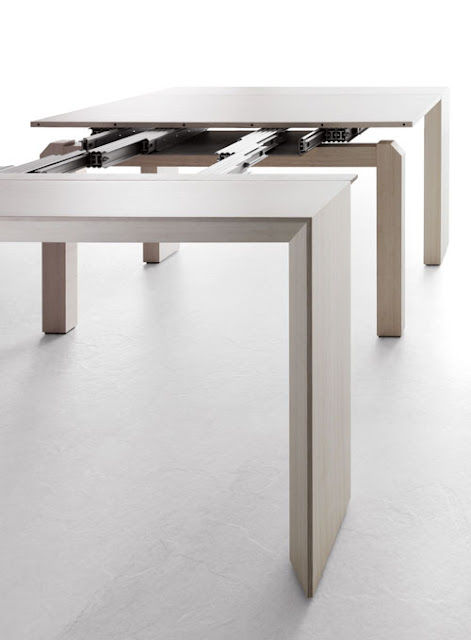
4. Minuetto Space-Saving Table
Produced by Italian manufacturer Milano Smart Living, this piece is great for anyone living in tight quarters. "It starts out as a console table but quickly transforms into a large dining table big enough to seat 10 people"--um, what?! That, my friends, is good engineering.


5. Folditure Leaf Chair
Created by architect Alexander Gendell, this chair folds to less than 3/4" thick and can be hung in a closet when not in use. With an aluminum composite frame and sturdy mesh seat, this durable chair is suitable for both indoor and outdoor use.

6. Twin Chair
This chair, designed by Philippe Nigro, is a clever two-in-one deal that allows a person to use the chairs stacked, or two people to use them separated--great for times when you need extra seating but can't afford to have chairs taking up space on a full-time basis.

Are you a small space dweller? Do you have a piece of space-saving furniture that has made your life a little easier? Leave a comment and let us know!
sources: one . two . three . four . five . six . seven . eight . nine . ten . eleven
Let's take a look at a few of my favorites...and I don't know about you, but many of these made me think, "well duh, why didn't I think of that??"
1. Boxetti
Designed by Rolands Landsbergs, each modules "is designed to achieve maximum efficiency of particular demands for functionality and suitability," and boy, does it look good doing it. I love the modern look and clean lines of this collection--from the office, to the bedroom, to the kitchen, this line can make even the smallest spaces functional. Check out the full collection here.
2. Club
Created by Daniel Debiasi and Federico Sandri for the German manufacturer Schönbuch, this space saving mirror/wardrobe combo would be perfect in a small home or clothing store.
3. As if from nowhere...
Designed by Orla Reynolds, I can think of countless places that this piece would be useful, i.e. my own home! A fully functional bookcase discreetly houses two tables and four chairs, making the need to worry about unexpected guests a thing of the past.
4. Minuetto Space-Saving Table
Produced by Italian manufacturer Milano Smart Living, this piece is great for anyone living in tight quarters. "It starts out as a console table but quickly transforms into a large dining table big enough to seat 10 people"--um, what?! That, my friends, is good engineering.
5. Folditure Leaf Chair
Created by architect Alexander Gendell, this chair folds to less than 3/4" thick and can be hung in a closet when not in use. With an aluminum composite frame and sturdy mesh seat, this durable chair is suitable for both indoor and outdoor use.
6. Twin Chair
This chair, designed by Philippe Nigro, is a clever two-in-one deal that allows a person to use the chairs stacked, or two people to use them separated--great for times when you need extra seating but can't afford to have chairs taking up space on a full-time basis.
Are you a small space dweller? Do you have a piece of space-saving furniture that has made your life a little easier? Leave a comment and let us know!
sources: one . two . three . four . five . six . seven . eight . nine . ten . eleven
Subscribe to:
Posts (Atom)