Saturday, September 29, 2012
Cost-effective Advertising
Here at Advanced Cabinet Systems, we are always looking for ways to advertise our company that are both cost-effective and reach a large audience. I can't say that everything we do reaches our target audience, but it does help to get our name out there and give us more credibility within our field.
Below, is a compilation of free (or very inexpensive) ways to advertise your business online. All of which ACS is already taking advantage of--and reaping the rewards of a significant increase in website hits! Whether you are just starting your small business or have been established in your industry for years, a little free advertising never hurts, right?
1. Facebook: Last year Facebook introduced a new program aimed at helping small businesses promote their services. To access the free ad offer (worth $50)*, you will first need to take out an ad on Facebook, and then will be credited with $50 worth of free consumer clicks.
2. YouTube: Earlier this year, YouTube began giving away $50 million worth of $75 credits to small business owners when they sign up for a video advertising service. This service replicates many of the features from Google's AdWords, including pay-per-click and setting budgets for bids, but within the video advertising realm.
3. Pinterest: While I guess this isn't technically an advertising outlet, it is a great (free) way to promote your company by pinning things such as new products, completed projects, blog posts, and press releases.
4. LinkedIn: Similar to Facebook, LinkedIn allows businesses to claim a "company page" and provide information on their services, employees, job openings, and link to their company website. Another great feature is the fact that, unlike Facebook, LinkenIn does not offer as many interactive features--i.e. their is no "wall" to worry about maintaining--making it a great choice for employers that don't have the time or resources to spend updating statuses on a regular basis.
5. A Blog Platform: Whether you use Blogger, Typepad, WordPress, or any of the other numerous sites that offer free blogging platforms, a blog is a great, fairly easy way to give potential customers and job seekers a glimpse into what your company is all about. Blogging not only gets your name out there, but if done correctly, makes your company a resource by providing others with pertinent information on subjects in, or even outside, of your field.
Whether your company embraces one or all of these advertising outlets, they are great ways to increase your online presence and make your name more visible on search engine results. I will warn, however, that it is important to regularly maintain whatever accounts you decide to use, because honestly, how disappointing is it to find the company you have been searching for online but realize they haven't updated any of their information for the past two years?
Does your company take advantage of cost-effective or free advertising? Have you seen a difference in your sales numbers?
*Please note that this free offer is limited to the first 200,000 businesses, on a first-come, first-served basis.
sources: one
Friday, September 21, 2012
Avoiding Social Media Mistakes
I have to admit that I have never felt very compelled to network with other people in the design industry via social media. However, a few months back, my supervisor was featured on the Woodworking Network blog discussing the vital role that social media plays in making new business contacts and increasing sales figures (you can read the post in its entirety here).
After reading the article I could see where his arguments were coming from; social media is everywhere. Unless you don't have access to the internet or have an enormous amount of willpower to resist its pull, you too are most likely linked to it in some way or another.
I recently came across an article on Entrepreneur.com that gave several great tips that businesses who are just getting into the social media game would to wise to follow. Below is a quick run-down of what they had to say, but I would suggest that you check the article out here, it is a very informative read!
Mistakes to avoid when using social media for your business...
1. Starting without a plan
- Resist the temptation to skip creating a strategic plan that outlines your goals and any resources that you will need to reach those goals.
- Sit down with your staff and develop a well laid out plan that includes who is responsible for what.
- Know your customer and how they behave on social networks.
- Be sure to time your posts so that they are seen by the largest audience. Research has shown that the majority of people using social media live in Eastern and Central Time Zones. Therefore if you live live in the Pacific Time Zone and are posting the majority of your information near the end of the work day, you have missed the boat on the largest possible audience seeing what you have to say.
- Before you start, be sure to familiarize yourself with some of the basic "rules" of social media.
- Start conversations by asking thought-provoking conversations.
- Don't follow someone on twitter, then unfollow them when they begin following you.
- Promote other people as well as your own brand.
- Don't spread yourself too thin.
- Employ services that will help you measure the effectiveness of your social media campaign.
- Know who your competitors are and what they are up to.
- Keep a careful eye on their social media campaigns and use their followers praises and complaints to shape your own online presence.
Sources: one
Friday, September 14, 2012
The ACS Catalog Goes 3D
By Kyle Rennaker, ACS Draftsman
In June 2012, Advanced Cabinet Systems released its first ever Advanced Cabinet Systems Revit Catalog. Up to this point, architects were responsible of creating “generic” casework as “fill-ins” for specifications in their 3D projects. Manufacturer-created 3D models, also known as Revit Families, help remove this trouble for architects by allowing them to easily download and drop them into their project.
Easy accessibility is just one benefit of having manufacturer-created material; there are many more reasons why it’s beneficial. One of the big benefits would be that each cabinet is to the standards of Advanced Cabinet Systems. Every size that is available is easily accessible through a “type catalog”. A type catalog gives all of the size options available through a pick-list without bogging down the model, thus keeping a relatively small file size. Finally, another great benefit is that specifying the cabinets in a project is easier because the matching product number associated with the physical catalog is included with each model. By loading in the “custom casework tag”, every floor plan would include the product number by being placed over the matching cabinet.
By having the manufacturer create their own Revit models, it creates a more stream-lined process for designers and architects in the overall build process.
Friday, September 7, 2012
Space Saving Furniture
I live in a small house--and when I say small, I mean it. We've got a downstairs with very little space division, a lofted upstairs, and two very, very small closets where I have to shove what seems like every possession we have into on a regular basis. To be perfectly clear, we need more space--or we need less stuff, whichever. Regardless, when I received an email from my boss recently about a new line of multipurpose, space saving furniture, it got me thinking about all the possibilities small spaces hold if a little forethought is put into their design and furnishings. Whether you are dealing with a small residence, office, or retail space, there are countless space saving ideas and fixtures that will meet a number of needs--all in one compact package.
Let's take a look at a few of my favorites...and I don't know about you, but many of these made me think, "well duh, why didn't I think of that??"
1. Boxetti
Designed by Rolands Landsbergs, each modules "is designed to achieve maximum efficiency of particular demands for functionality and suitability," and boy, does it look good doing it. I love the modern look and clean lines of this collection--from the office, to the bedroom, to the kitchen, this line can make even the smallest spaces functional. Check out the full collection here.
2. Club
Created by Daniel Debiasi and Federico Sandri for the German manufacturer Schönbuch, this space saving mirror/wardrobe combo would be perfect in a small home or clothing store.
3. As if from nowhere...
Designed by Orla Reynolds, I can think of countless places that this piece would be useful, i.e. my own home! A fully functional bookcase discreetly houses two tables and four chairs, making the need to worry about unexpected guests a thing of the past.
4. Minuetto Space-Saving Table
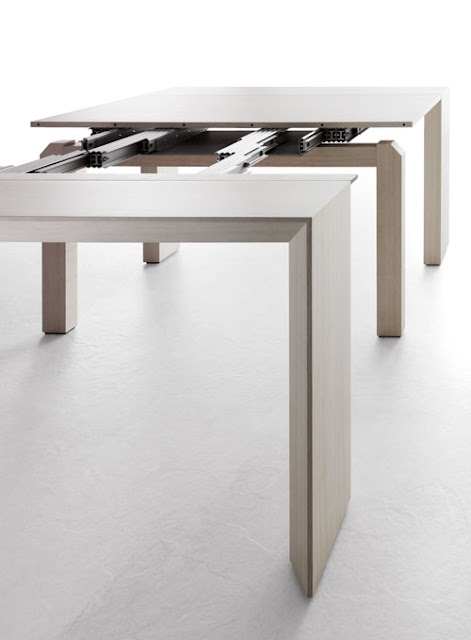
Produced by Italian manufacturer Milano Smart Living, this piece is great for anyone living in tight quarters. "It starts out as a console table but quickly transforms into a large dining table big enough to seat 10 people"--um, what?! That, my friends, is good engineering.
5. Folditure Leaf Chair
Created by architect Alexander Gendell, this chair folds to less than 3/4" thick and can be hung in a closet when not in use. With an aluminum composite frame and sturdy mesh seat, this durable chair is suitable for both indoor and outdoor use.
6. Twin Chair
This chair, designed by Philippe Nigro, is a clever two-in-one deal that allows a person to use the chairs stacked, or two people to use them separated--great for times when you need extra seating but can't afford to have chairs taking up space on a full-time basis.
Are you a small space dweller? Do you have a piece of space-saving furniture that has made your life a little easier? Leave a comment and let us know!
sources: one . two . three . four . five . six . seven . eight . nine . ten . eleven
Let's take a look at a few of my favorites...and I don't know about you, but many of these made me think, "well duh, why didn't I think of that??"
1. Boxetti
Designed by Rolands Landsbergs, each modules "is designed to achieve maximum efficiency of particular demands for functionality and suitability," and boy, does it look good doing it. I love the modern look and clean lines of this collection--from the office, to the bedroom, to the kitchen, this line can make even the smallest spaces functional. Check out the full collection here.
2. Club
Created by Daniel Debiasi and Federico Sandri for the German manufacturer Schönbuch, this space saving mirror/wardrobe combo would be perfect in a small home or clothing store.
3. As if from nowhere...
Designed by Orla Reynolds, I can think of countless places that this piece would be useful, i.e. my own home! A fully functional bookcase discreetly houses two tables and four chairs, making the need to worry about unexpected guests a thing of the past.
4. Minuetto Space-Saving Table
Produced by Italian manufacturer Milano Smart Living, this piece is great for anyone living in tight quarters. "It starts out as a console table but quickly transforms into a large dining table big enough to seat 10 people"--um, what?! That, my friends, is good engineering.
5. Folditure Leaf Chair
Created by architect Alexander Gendell, this chair folds to less than 3/4" thick and can be hung in a closet when not in use. With an aluminum composite frame and sturdy mesh seat, this durable chair is suitable for both indoor and outdoor use.
6. Twin Chair
This chair, designed by Philippe Nigro, is a clever two-in-one deal that allows a person to use the chairs stacked, or two people to use them separated--great for times when you need extra seating but can't afford to have chairs taking up space on a full-time basis.
Are you a small space dweller? Do you have a piece of space-saving furniture that has made your life a little easier? Leave a comment and let us know!
sources: one . two . three . four . five . six . seven . eight . nine . ten . eleven
Wednesday, August 29, 2012
Retail Security Solutions
Working in the retail fixture industry, Advanced Cabinet Systems fulfills numerous requests from customers wanting their displays to be as secure as possible. Would-be thieves are getting craftier and often times it seems that if a product is not nailed down, there is the potential that it will grow legs and walk right out of your store. If your security devices can be picked, cut, deactivated, or broken off, someone will find a way--resulting in a loss of profit for your business and loads of frustration for you.
In order to offer our customers the best security devices to meet an ever-growing list of needs, we try to stay as up to date as possible on what the market has to offer. Below are a few of our go-to products that we have found to be reliable options for combating retail theft. This may seem like a paid advertisement for one company, but trust me it's not, we just really like their products!
1. Invue Series 1000 Impact Display Stands
These stands feature an internal recoil mechanism that returns the product to the display position each time it is handled. It also has a built-in alarm that will sound if the device is disconnected from the stand--and speaking from experience, it is a loud alarm that no one in the store is going to miss! These stands provide users with a lot of flexibility, giving them the option to secure dummy phones, charge live phones, or provide customers with an interactive display that is triggered when the device is lifted from the base.
2. Invue Locking Gridwall Hooks
4. Invue Cabinet Lock
Invue cabinet locks are great choice for retailers looking to retrofit existing cabinetry--with no tools or drilling required, installation is a snap. This lock features PowerTouch technology that transfers power from the key to the lock, meaning you will never have to worry about replacing batteries, providing years of worry-free security.
5. Invue LTO2 Tablet Security
New to Invue, this product can power up any tablet on the market while keeping it secure and functional when on display. The display stand allows the product to be mounted either vertically or horizontally, while remaining virtually invisible from the front--keeping product displays clean and uncluttered.
A large portion of my design work is geared toward the technology industry and I realize that is where most of these security solutions would be most useful. So, I would love to hear from you--what kind of security measures do you take to ensure that your merchandise doesn't fall prey to sticky fingers?
sources: one . two . three . four . five
In order to offer our customers the best security devices to meet an ever-growing list of needs, we try to stay as up to date as possible on what the market has to offer. Below are a few of our go-to products that we have found to be reliable options for combating retail theft. This may seem like a paid advertisement for one company, but trust me it's not, we just really like their products!
1. Invue Series 1000 Impact Display Stands
These stands feature an internal recoil mechanism that returns the product to the display position each time it is handled. It also has a built-in alarm that will sound if the device is disconnected from the stand--and speaking from experience, it is a loud alarm that no one in the store is going to miss! These stands provide users with a lot of flexibility, giving them the option to secure dummy phones, charge live phones, or provide customers with an interactive display that is triggered when the device is lifted from the base.
2. Invue Locking Gridwall Hooks
Many of our customers stock their accessories on grid wall panels, and these locking hooks from Invue are a great way to keep products secure, while still being quick and easy for employees to remove when necessary.
3. Vanguard Cell Phone Security Stands
Similar to the Invue stands above, Vanguard Products Group offers a wide range of security options for hand held devices, tablets, and accessories. These devices offer the same user-friendly options when it comes to displaying products, while providing peace of mind that items are safe and secure.4. Invue Cabinet Lock
Invue cabinet locks are great choice for retailers looking to retrofit existing cabinetry--with no tools or drilling required, installation is a snap. This lock features PowerTouch technology that transfers power from the key to the lock, meaning you will never have to worry about replacing batteries, providing years of worry-free security.
5. Invue LTO2 Tablet Security
New to Invue, this product can power up any tablet on the market while keeping it secure and functional when on display. The display stand allows the product to be mounted either vertically or horizontally, while remaining virtually invisible from the front--keeping product displays clean and uncluttered.
A large portion of my design work is geared toward the technology industry and I realize that is where most of these security solutions would be most useful. So, I would love to hear from you--what kind of security measures do you take to ensure that your merchandise doesn't fall prey to sticky fingers?
sources: one . two . three . four . five
Monday, August 20, 2012
Shipping Container Stores
As I was going through my undergrad schooling for interior design, the use of shipping containers as building structures was quickly gaining steam. Fast forward a few years (many of which I paid little attention to this trend) and I am admittedly behind the curve. However, over the past few months of work related research, several retail stores made entirely of shipping containers have flashed across my screen, and given the overabundance of really cool designs that they typically employ, I couldn't resist any longer in compiling a small list of a few of my favorites.
Reusing shipping containers is not only good for the environment, but is also a good option for retailers looking to save a few bucks, as they can typically be purchased for around $2000. They are also make great pop-up shops, offering a portable structure that is durable and easy to ship from one location to the next.
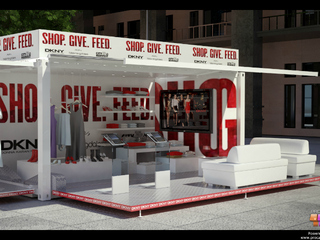
Last year, DKNY offered a small sampling of its wares throughout Manhattan, housing them in a shipping container pop-up store. The need for a easy to set up (it took less than an hour!), portable design was critical to this project, as the store changed locations each day over the course of the three day event.
In 2010, fashion designer Richard Chai opened a pop-up store in Manhattan. Costing a mere $5,000, this location paired high fashion with flawless interior design.
Starbucks Reclamation Drive Thru located in Tukwila, Washington has garnered a lot of attention since the 450 sq ft portable structure was constructed. Comprised of four salvaged shipping containers, it was designed specifically to explore new options in sustainability--showcasing the company's ongoing dedication to providing sustainable structures and business practices.
This shipping container houses the Ilan Dei Studio pop-up store and project lab, which opened in Venice, California earlier this month. The primary goal of this clean, modern design is to showcase the indoor-outdoor living of the California lifestyle. Three separate sections house a traditional lifestyle store, art gallery, and a community area for events such as yoga classes and ping pong games.
One of my all time favorite use of salvaged shipping containers is Container City located in Cholula, Mexico. Restaurants, galleries, bars, stores and living spaces occupy the nearly 50 colorful containers carefully arranged to form courtyards, alleys, and streets.
The possibilities are endless when it comes to employing recycled shipping containers in design. From temporary pop-up stores to permanent cities, these structures provide a durable, eco-friendly alternative to conventional construction methods. This is one craze that has definitely caught my attention, and I anticipate it hanging around for many more years to come!
sources: one . two . three . four . five . six . seven
Reusing shipping containers is not only good for the environment, but is also a good option for retailers looking to save a few bucks, as they can typically be purchased for around $2000. They are also make great pop-up shops, offering a portable structure that is durable and easy to ship from one location to the next.
Last year, DKNY offered a small sampling of its wares throughout Manhattan, housing them in a shipping container pop-up store. The need for a easy to set up (it took less than an hour!), portable design was critical to this project, as the store changed locations each day over the course of the three day event.
In 2010, fashion designer Richard Chai opened a pop-up store in Manhattan. Costing a mere $5,000, this location paired high fashion with flawless interior design.
Starbucks Reclamation Drive Thru located in Tukwila, Washington has garnered a lot of attention since the 450 sq ft portable structure was constructed. Comprised of four salvaged shipping containers, it was designed specifically to explore new options in sustainability--showcasing the company's ongoing dedication to providing sustainable structures and business practices.
This shipping container houses the Ilan Dei Studio pop-up store and project lab, which opened in Venice, California earlier this month. The primary goal of this clean, modern design is to showcase the indoor-outdoor living of the California lifestyle. Three separate sections house a traditional lifestyle store, art gallery, and a community area for events such as yoga classes and ping pong games.
One of my all time favorite use of salvaged shipping containers is Container City located in Cholula, Mexico. Restaurants, galleries, bars, stores and living spaces occupy the nearly 50 colorful containers carefully arranged to form courtyards, alleys, and streets.
The possibilities are endless when it comes to employing recycled shipping containers in design. From temporary pop-up stores to permanent cities, these structures provide a durable, eco-friendly alternative to conventional construction methods. This is one craze that has definitely caught my attention, and I anticipate it hanging around for many more years to come!
sources: one . two . three . four . five . six . seven
Monday, August 13, 2012
Building Information Modeling
In June, Advanced Cabinet Systems announced the release of their Revit Families Catalog. This was a significant step for the company in providing resources that meet the ever-changing demands of technology in the architectural community, while also allowing ACS products to be integrated into their drawings. In light of this release, I wanted to take a look at Building Information Modeling (BIM) and how it is helping to change the face of building construction.
The National Building Information Modeling Standard Project Committee (try saying that three times fast), defines BIM as "a digital representation of physical and functional characteristics of a facility. A BIM is a shared knowledge resource for information about a facility forming a reliable basis for decisions during its life-cycle; defined as existing from earliest conception to demolition." Now, after reading that definition I was still a little in the dark about what BIM actually was, so in case you are too, hopefully the rest of this post will clear it up a little better...
Building Information Modeling goes beyond the standard 2D drawings often used in construction, and renders the entire space in 3D--while also allowing the user to see the time and cost associated with each phase of the process. This allows for quick extraction of different views of the building, saving time and resources that would otherwise be spent on the drafting table, and allowing the project to proceed without delay. If problems are detected within the drawing, elements can be easily changed while also maintaining an updated schedule of materials for ordering and tracking purposes.

Another major benefit of BIM is the ease of which a job can be handed off from one person to the next. Gone are the days of having to keep track of page after page of changes and revisions, with BIM each worker adds to a single drawing file and hands it down to the next--lowering the potential that information will be lost in the process and reducing the chance that costly mistakes will be made as a result.
With tight schedules and budget constraints, Building Information Modeling helps architects, builders, and designers work quickly and efficiently by allowing them to visualize the space from start to finish. This allows them to work out any potential problems before construction even begins; saving valuable time and resources, and often leading to projects that finish ahead of schedule and under-budget.
sources: one . two . three . four
The National Building Information Modeling Standard Project Committee (try saying that three times fast), defines BIM as "a digital representation of physical and functional characteristics of a facility. A BIM is a shared knowledge resource for information about a facility forming a reliable basis for decisions during its life-cycle; defined as existing from earliest conception to demolition." Now, after reading that definition I was still a little in the dark about what BIM actually was, so in case you are too, hopefully the rest of this post will clear it up a little better...
Building Information Modeling goes beyond the standard 2D drawings often used in construction, and renders the entire space in 3D--while also allowing the user to see the time and cost associated with each phase of the process. This allows for quick extraction of different views of the building, saving time and resources that would otherwise be spent on the drafting table, and allowing the project to proceed without delay. If problems are detected within the drawing, elements can be easily changed while also maintaining an updated schedule of materials for ordering and tracking purposes.
Another major benefit of BIM is the ease of which a job can be handed off from one person to the next. Gone are the days of having to keep track of page after page of changes and revisions, with BIM each worker adds to a single drawing file and hands it down to the next--lowering the potential that information will be lost in the process and reducing the chance that costly mistakes will be made as a result.
With tight schedules and budget constraints, Building Information Modeling helps architects, builders, and designers work quickly and efficiently by allowing them to visualize the space from start to finish. This allows them to work out any potential problems before construction even begins; saving valuable time and resources, and often leading to projects that finish ahead of schedule and under-budget.
sources: one . two . three . four
Subscribe to:
Posts (Atom)